Artificial intelligence is rapidly transforming the way businesses interact with their customers.
Today, many SMEs are looking to automate:
customer support,
lead qualification,
repetitive replies,
or certain internal tasks.
But one confusion keeps coming up:
What is the difference between a chatbot and an AI Agent?
Both technologies use artificial intelligence, but they don't work at all in the same way.
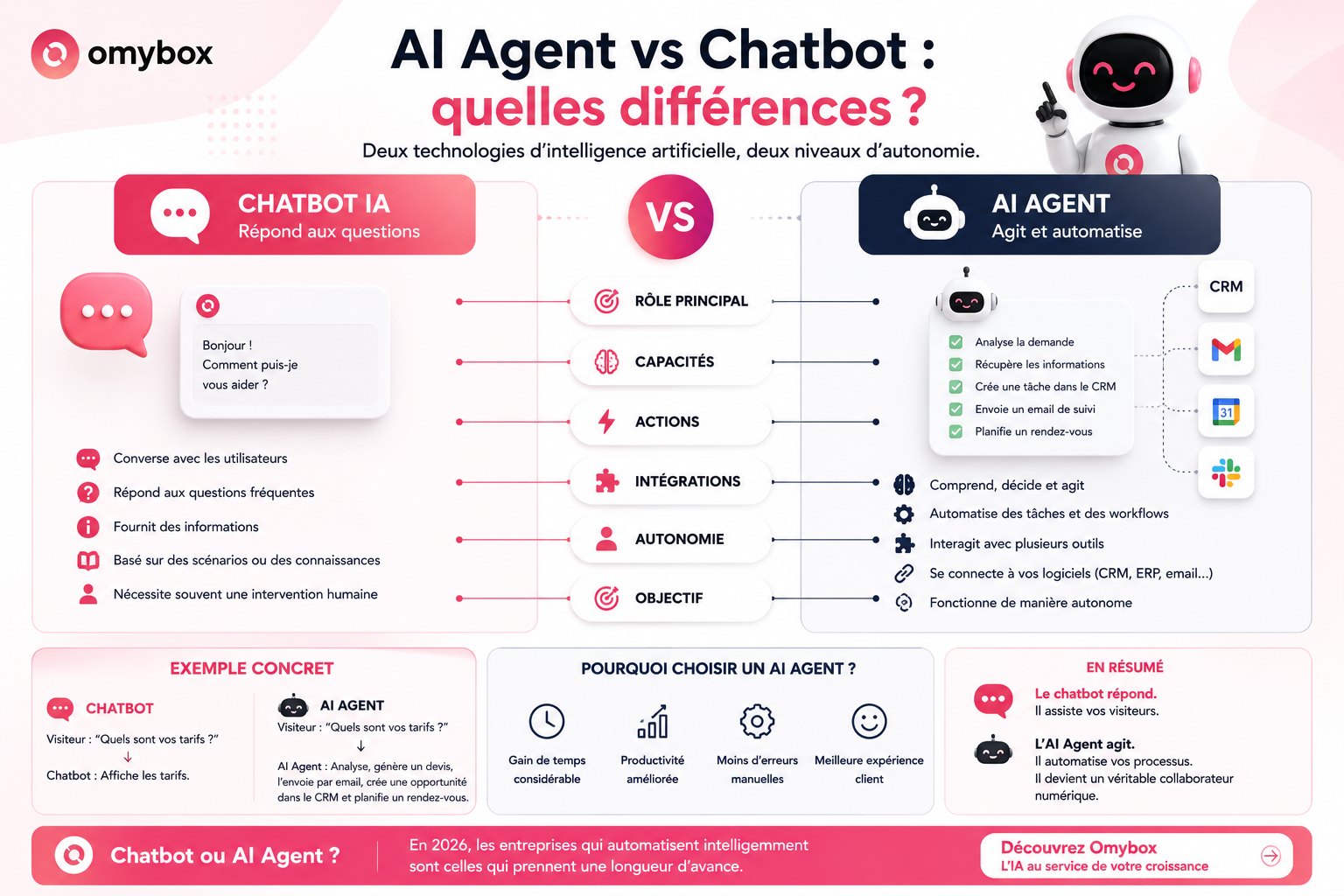
In 2026, AI Agents represent a new generation of intelligent assistants capable not only of replying, but also of acting, automating and taking decisions within certain workflows.
What is an AI chatbot?
An AI chatbot is a conversational assistant designed mainly to:
answer questions,
assist visitors,
automate simple exchanges,
and improve the user experience.
Modern chatbots now use:
natural language processing,
models such as GPT-4, Claude or Gemini,
and generative artificial intelligence.
Unlike older chatbots with fixed scripts, they can sustain a more natural conversation.
However, their role remains mainly conversational.
What is an AI Agent?
An AI Agent goes much further.
It doesn't just chat.
It can:
make decisions,
trigger actions,
interact with several tools,
automate complete workflows,
and carry out tasks without human intervention.
An AI Agent acts as a genuine autonomous digital colleague.
For example, an AI Agent can:
✔️ reply to a prospect,
✔️ retrieve their details,
✔️ automatically create a CRM record,
✔️ send a follow-up email,
✔️ schedule an appointment,
✔️ and pass the request on to the right team.
All of this without human intervention.
The main difference: replying vs acting
The fundamental difference is simple:
The chatbot replies.
It assists visitors within a conversation.
The AI Agent acts.
It can automate real actions within the business.
The limitations of traditional chatbots
Even modern AI chatbots have certain limitations.
They excel at:
answering frequently asked questions,
guiding visitors,
or providing information.
But they often remain limited when it comes to:
making complex decisions,
chaining several actions together,
or managing business workflows.
In many cases, they still require:
human validation,
manual intervention,
or pre-configured scenarios.
Why AI Agents are booming in 2026
Today, businesses are looking to:
save time,
reduce repetitive tasks,
automate more processes,
and boost their productivity.
AI Agents meet this shift perfectly.
Thanks to advances in artificial intelligence, they can now:
✔️ understand context,
✔️ access company data,
✔️ use several tools at once,
✔️ automate complex workflows,
✔️ and collaborate with teams.
A practical example: chatbot vs AI Agent
Example with a chatbot
A visitor asks:
"Could you give me your prices?"
The chatbot:
✔️ displays the prices,
✔️ answers the question,
✔️ and possibly suggests a form.
Example with an AI Agent
The same visitor asks:
"Could you give me your prices?"
The AI Agent can:
✔️ analyse the prospect's needs,
✔️ identify the right department,
✔️ retrieve the necessary information,
✔️ automatically generate a quote,
✔️ send a personalised email,
✔️ schedule an appointment,
✔️ and create a sales opportunity in the CRM.
AI Agents are transforming SMEs
AI Agents are gradually becoming:
sales assistants,
support assistants,
administrative assistants,
and operational copilots.
In particular, they make it possible to:
✔️ automate emails,
✔️ manage appointments,
✔️ qualify leads,
✔️ process documents,
✔️ centralise information,
✔️ and improve the customer relationship.
AI Agents and business integrations
A true AI Agent is capable of connecting to:
CRM,
ERP,
Google Workspace,
Slack,
Notion,
Asana,
ClickUp,
or internal software.
This connection allows the AI to:
✔️ access data,
✔️ trigger actions,
✔️ and automate complete workflows.
The advantages of AI Agents
✔️ Advanced automation
✔️ Significant time saving
✔️ Fewer repetitive tasks
✔️ Improved productivity
✔️ 24/7 assistance
✔️ Intelligent workflow management
✔️ Better customer experience
✔️ Fewer human errors
The current limitations of AI Agents
Even though AI Agents are progressing rapidly, some limitations still exist.
They can:
make mistakes,
misinterpret certain requests,
or lack specific industry understanding.
Human oversight therefore remains important, particularly for:
sensitive decisions,
important approvals,
or regulated sectors.
Chatbot or AI Agent: which should you choose?
It all depends on your needs.
Choose a chatbot if:
you want to answer visitors' questions,
you want to automate an FAQ,
or you want to improve simple customer support.
Choose an AI Agent if:
you want to automate processes,
you want to connect several tools,
you need to manage complex workflows,
or you want to gain the greatest possible productivity.
Omybox: towards a new generation of AI assistants
New platforms such as Omybox are gradually evolving from the simple chatbot towards far more intelligent AI assistants.
The goal:
✔️ respond naturally,
✔️ understand context,
✔️ automate repetitive tasks,
✔️ qualify prospects,
✔️ and help SMEs save time.
AI Agents today represent the logical evolution of conversational assistants.
FAQ – AI Agent vs chatbot
What is the difference between a chatbot and an AI Agent?
A chatbot mainly answers users' questions, whereas an AI Agent can also automate actions, carry out tasks and manage complete workflows.
Does an AI Agent use generative artificial intelligence?
Yes. Modern AI Agents use advanced models such as GPT-4, Claude or Gemini to understand natural language and make contextual decisions.
Will AI Agents replace employees?
No. AI Agents mainly automate repetitive tasks so that human teams can focus on higher-value work.
What is the main advantage of an AI Agent?
The main advantage is its ability to act automatically: creating tasks, sending emails, managing workflows or interacting with several software tools without human intervention.
Can SMEs use AI Agents?
Yes. AI Agents are becoming increasingly accessible to SMEs thanks to no-code solutions and simple-to-deploy platforms such as Omybox.
Conclusion
In 2026, businesses are gradually moving:
from the simple conversational chatbot,
towards AI Agents capable of automating real tasks.
The difference is major:
✔️ the chatbot responds,
✔️ the AI Agent acts.
Businesses able to intelligently integrate these new AI assistants will be able to:
✔️ save time,
✔️ automate their workflows,
✔️ improve their productivity,
✔️ and offer a better customer experience.
Because today, AI is no longer just for conversation.
It is now used to get work done.
Go further
Further resources, chosen for this topic.
AI assistant for dental clinics
A complete example: patient questions, emergencies and appointment booking.
Omybox or Chatbase: the differences
Automated answers from your own data
Omybox plans and pricing
Find the plan that fits your visitor volume.
Omybox help centre
Installation, personalisation and conversation tracking.
Read next
All articlesBest Belgian AI Chatbox in 2026: Why Omybox Stands Out as the Market Benchmark
2 June 2026 · 3 min
ComparisonChatbase alternative: which AI solution should you choose in 2026?
25 May 2026 · 5 min
ComparisonBest AI chatbot for Shopify in 2026: which one to choose for your e-commerce store?
17 May 2026 · 7 min