
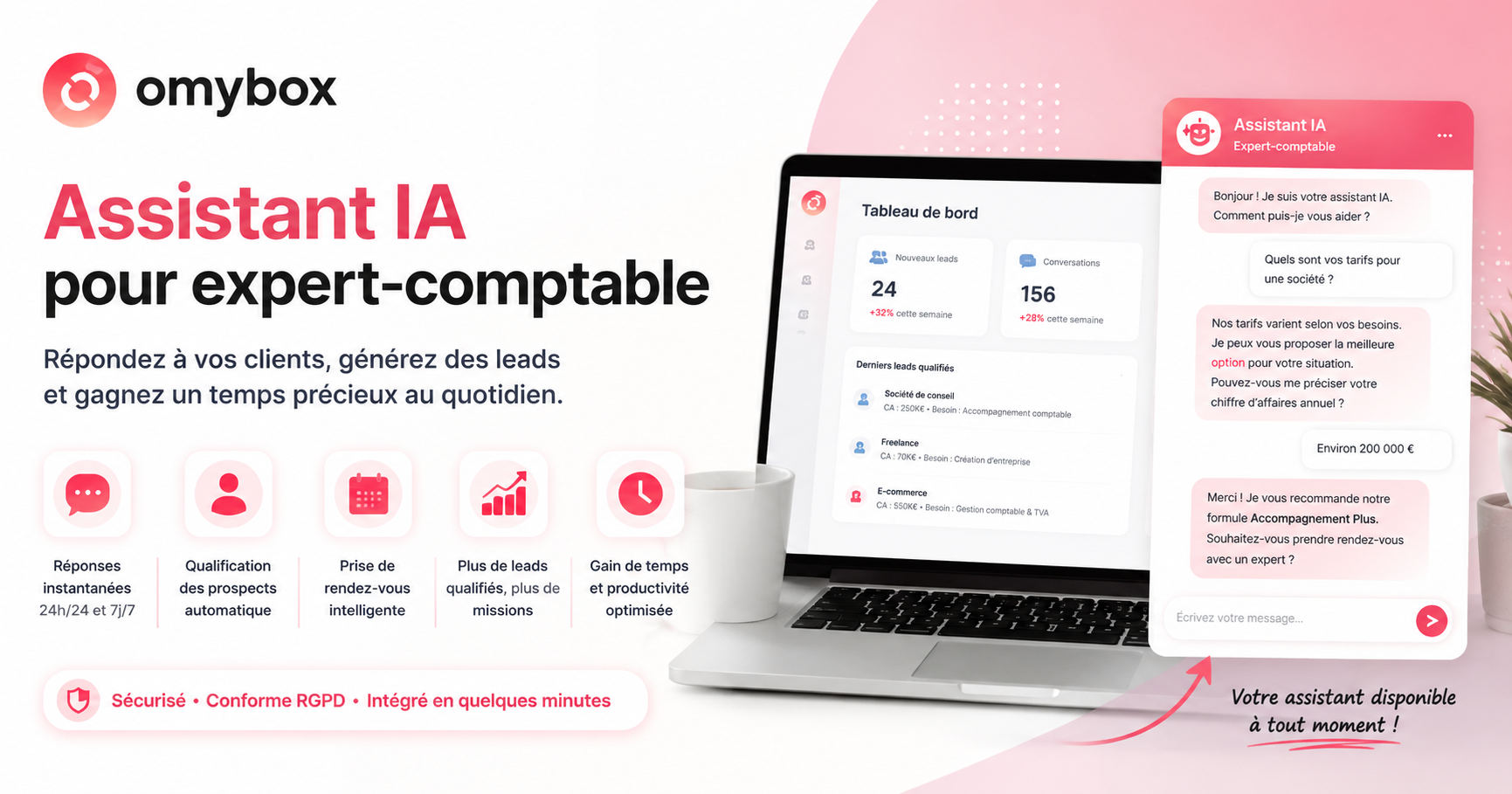
The accountancy profession is evolving quickly. Between regulatory obligations, client requests, file management and administrative tasks, accounting practices now face an ever-growing workload.
In this context, artificial intelligence represents a genuine opportunity.
An AI assistant for accountants can automate many interactions, improve the client experience and free up valuable time for high-value work.
What is an AI assistant for accountants?
An AI assistant is an intelligent tool capable of automatically conversing with the visitors to your website or with your clients.
Unlike a traditional chatbot, it understands the context of requests: in this context, artificial intelligence is transforming accounting and the profession by relying on natural language and generative AI to produce more relevant answers.
It can become a real asset for your accounting practice thanks to well-deployed tools and solutions:
answer frequently asked questions;
present your services;
guide prospects;
collect information;
qualify enquiries;
book appointments;
assist your clients 24/7.
The goal is not to replace the accountant, but to let them focus on strategic work while keeping control.
Why are accounting practices increasingly using AI?
Accounting firms receive dozens of similar questions every day:
What are your fees?
How do I set up a company?
What documents do I need for a VAT return?
What is the deadline for filing annual accounts?
Do you offer support for self-employed workers?
Do you work with limited companies?
These requests take up time, yet they can be handled automatically by one of the tools built on generative AI, with an automation logic that relieves your team. Unlike a traditional chatbot, this assistant understands requests in natural language, presents them clearly and helps measure their operational impact. Its potential is real for smoothing exchanges without diluting the service.
The result:
fewer interruptions;
fewer unnecessary calls;
more availability for existing clients;
faster response times, while leaving the accountant in control of answers and the client relationship.
The benefits and time savings of an AI assistant for accountants
Automatically answer frequently asked questions
The AI assistant can instantly answer the most common questions.
Your visitors get an immediate answer, even outside opening hours.
This improves the user experience while reducing your team's workload.
Generate more qualified leads
Not every visitor to your site is necessarily a potential client, and an AI assistant can also help draft answers or technical notes to handle a business's recurring questions more quickly.
An AI assistant can automatically qualify enquiries by asking questions such as:
Are you self-employed or a company?
What is your turnover?
Are you looking for one-off or ongoing support?
Where are you based?
This way you receive more qualified leads, with a better understanding of incoming requests. Generative AI can also help write explanatory content to clearly address the needs expressed.
Book appointments automatically
The AI assistant can directly offer an appointment with a member of the practice.
This cuts unnecessary back-and-forth and speeds up first contact. It can also act as a right-hand man by qualifying the request, which can reveal a business's potential and point it towards the right support. Some AI assistants also help identify financial trends and project cash flows from historical data, to better qualify needs.
Improve customer satisfaction
Clients today expect quick answers, and an assistant becomes a true digital right-hand man, able to respond accurately and directly offer an appointment with the right person.
Thanks to AI, they get immediate help based on up-to-date information, without having to wait for a reply by email or phone.
Available 24/7
Your practice closes in the evening.
Your AI assistant keeps working.
It answers visitors, collects information and generates opportunities even when nobody is available.
Examples of use in an accounting firm
For self-employed professionals
The AI assistant can answer questions relating to:
In an accounting practice, different AI solutions can be deployed depending on needs; some approaches, backed by software vendors such as Cegid, also focus on a more proactive way of supporting clients. During a pilot phase, categorising documents such as invoices makes it possible to concretely assess the time savings and the reliability of the suggestions.
at business launch;
on VAT;
on social security contributions;
on invoicing.
For companies
It can guide business owners on:
company formation;
accounting obligations;
annual accounts;
tax returns;
invoicing, with AI-powered invoice processing to support finance teams;
reporting and the automation of certain tasks by agents.
AI automatically scans and reads invoices and receipts, which also helps spot points of vigilance more quickly.
It reduces manual work when categorising transactions and can cut data entry time by 70 to 80%.
It instantly matches bank transactions with the corresponding invoices.
For existing clients
The assistant can provide:
practical information;
the firm's contact details;
opening hours;
internal procedures;
an internal usage guide;
privacy rules;
a request for a commitment signature.
It can also support corporate finance by automatically generating financial reports.
AI agents can spot anomalies in the accounts before they become problems.
It also helps identify points of vigilance and stays updated in real time with the latest tax regulations.
How does an AI assistant for accountants work and keep data secure?
Setting it up is usually very straightforward.
The assistant is trained using:
your website;
your service pages;
your FAQ;
your documentation;
your internal procedures, with AI usage rules that also apply to existing clients depending on your environment;
your working files, including where some processing still relies on Excel.
A guide, or better still a charter for using AI, is an essential building block for security. It reinforces vigilance, frames the systems used and can go as far as a signing step where a confidentiality or proper-use commitment is required.
Once configured, it is able to answer visitors consistently and relevantly.
The more precise your content, the better the answers will perform.
AI assistant, chatbot or generative artificial intelligence: what's the difference?
A traditional chatbot often works with predefined scripts and fixed rules.
An AI assistant goes much further, as it learns from examples rather than being limited to closed sequences.
It understands:
the context;
the user's intent;
the conversation history.
No personal data should be uploaded to unsecured platforms.
GDPR imposes strict obligations on the handling of sensitive data.
It is therefore able to offer a far more natural and effective experience.
For an accounting firm, this difference is essential because client requests are rarely identical. The technical environment and the systems used must also be secure, as centralised client data is a potential target for cyberattacks, and the aim is also to move away from scattered Excel practices where they undermine reliability and traceability. A charter is a first building block of governance, to be completed by an AI compliance audit to strengthen data security.
Why integrate an AI assistant on your firm's website?
Your website is often the first point of contact with your future clients.
Unlike a chatbot based on fixed rules, an AI assistant allows you to:
welcome visitors;
answer questions;
reassure prospects;
present your services;
convert more visitors into clients.
An AI assistant goes much further. Algorithms can also reproduce historical biases, with a possible impact on privacy, which calls for appropriate oversight. It becomes a genuine digital colleague supporting the growth of your firm and the advice you give your clients.
What is an AI assistant for accountants?
An AI assistant for accountants is a tool that can automatically answer client questions, qualify prospects and automate certain communication tasks.
Why should an accounting firm use AI?
AI saves time, improves customer satisfaction, responds instantly to enquiries and generates more qualified leads.
Can an AI assistant replace a chartered accountant?
No. It supports the practice with repetitive tasks, but it does not replace the human expertise required for accounting and tax work.
How much does an AI assistant for an accounting practice cost?
The cost depends on the features and the level of usage. The time saved and the leads generated usually pay back the investment quickly.
How do you add an AI assistant to an accountant's website?
Integration is usually done in a few minutes using your existing website, with no complex development.
Conclusion
Accounting practices that adopt artificial intelligence get a head start.
An AI assistant for accountants not only saves time, but also improves the customer experience, automates repetitive tasks and generates more business opportunities, provided you configure the content, access and usage rules carefully before going live.
In a sector where responsiveness and quality of service make the difference, AI becomes a genuine growth lever for chartered accountants, while helping them anticipate the changes in the profession.
Go further
Further resources, chosen for this topic.
AI assistant for dental clinics
A complete example: patient questions, emergencies and appointment booking.
Omybox or Chatbase: the differences
Automated answers from your own data
Omybox plans and pricing
Find the plan that fits your visitor volume.
Omybox help centre
Installation, personalisation and conversation tracking.
Read next
All articlesWordPress chatbot plugin: which is the best in 2026?
5 July 2026 · 10 min
TutorialAI assistant for yoga studios: how to generate more bookings with artificial intelligence?
15 June 2026 · 6 min
TutorialAI assistant for Pilates: how to boost your bookings with artificial intelligence?
15 June 2026 · 6 min