
AI assistant for notaries: improve client reception and automate repetitive requests
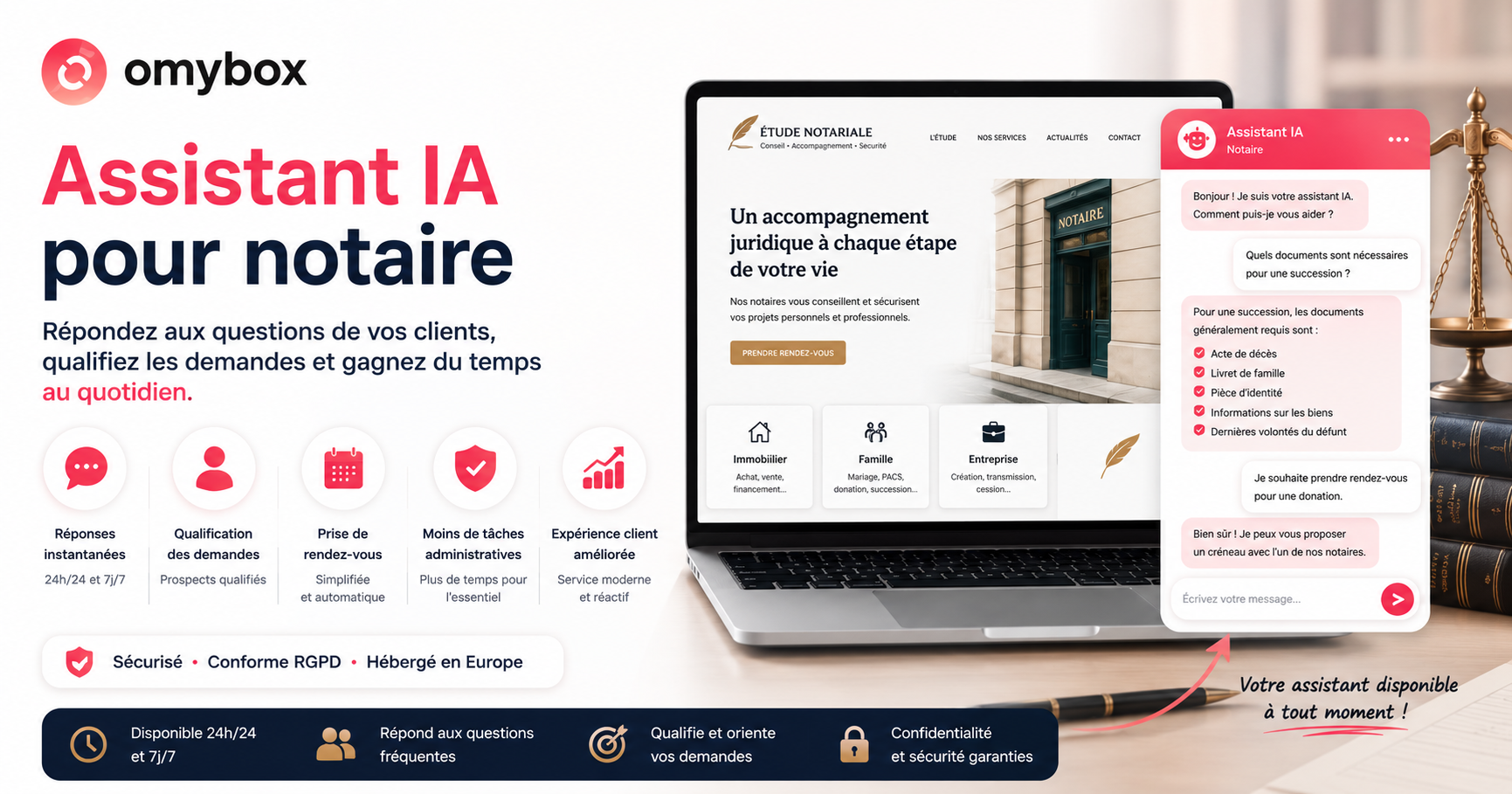
Notarial offices face a large volume of requests every day. Questions about an estate, property purchase, gifts, marriage contracts, appointment booking or documents to provide: a large share of these exchanges concerns recurring information.
This administrative load takes up time and sometimes slows down the handling of high-value cases.
Thanks to artificial intelligence, notarial offices now have a modern solution to improve their client relationships: the AI assistant.
Available 24/7, it can answer frequently asked questions, guide visitors and qualify enquiries before the notary gets involved.
What is an AI assistant for notaries?
An AI assistant for notaries is an intelligent conversational tool that can interact with the visitors to your website.
Unlike a simple chatbot, it understands the context of questions and provides personalised answers based on the information on your website.
It can, in particular:
answer frequently asked questions;
explain certain procedures;
direct visitors to the right department;
qualify enquiries;
collect useful information;
make appointment booking easier.
Its aim is to improve the client experience while reducing repetitive requests made to the office.
Why do notarial offices use artificial intelligence?
Notaries receive similar requests every day:
Which documents are needed for an estate?
How much does a notarised deed cost?
How do I prepare for a property purchase?
What are the deadlines for a gift?
How do I book an appointment with a notary?
These questions are important but often repetitive.
An AI assistant can provide an immediate first answer while leaving staff more time to handle complex cases.
The benefits of an AI assistant for a notarial office
Answering frequently asked questions
The AI assistant can instantly provide answers about:
estates;
gifts;
property sales;
wills;
marriage contracts;
administrative formalities.
Visitors quickly get the information they are looking for.
Qualifying enquiries before contact
Before a staff member steps in, the assistant can collect essential information:
type of case;
urgency of the request;
client contact details;
purpose of the consultation.
The office thus gains valuable time.
Making appointment booking easier
The AI assistant can guide visitors to the appointment booking that suits their situation.
It becomes a genuine organisational tool for the practice.
Available 24/7
Your clients don't always visit your website during opening hours.
The AI assistant remains available at all times to answer questions and collect enquiries.
Reducing the administrative load
A large share of calls and emails concerns simple requests.
Automating these exchanges improves the team's productivity and allows it to focus on high-value legal work. It also reduces human error in repetitive tasks.
Use cases in a notarial office
Property purchase
The assistant can explain:
the steps of an acquisition;
the costs linked to the purchase;
the documents to prepare;
the role of the notary.
Estate
It can provide general information about:
the procedures;
the documents required;
the usual timescales.
AI can also summarise hundreds of pages of a file to quickly extract the relevant rights and obligations.
It also makes document searches in notarial archives easier and helps find a specific legal point faster in large databases.
Gifts and transfer of wealth
Visitors can obtain preliminary information before booking an appointment with a notary.
First contact
The assistant qualifies the enquiry and directs the client to the right contact.
AI assistant or chatbot for notaries?
Traditional chatbots usually work with predefined scripts, whereas an AI chatbot is still more limited than a conversational agent able to take the exchange further.
AI assistants use advanced models, built on natural language processing, to understand natural language queries, interpret human language and rely on language models to generate responses:
the context;
the intentions;
the natural phrasing users choose.
Machine learning also improves the quality of responses over time.
The experience is far smoother and more relevant.
This difference matters particularly in the legal sector, where situations are often complex, although an AI assistant for notaries can still struggle with ambiguous requests.
Why add an AI assistant to a notary's website?
The website is often the first point of contact with a future client. In terms of usage, 66% of French people already use chatbots for customer service, which reinforces the relevance of integrating one into a notary's website.
An AI assistant allows you to:
welcome visitors;
answer questions;
reassure clients;
simplify procedures;
improve appointment booking.
It helps strengthen the modern, forward-thinking image of the practice.
Artificial intelligence at the service of notaries
AI does not replace the notary.
It simply automates repetitive tasks so that professionals can devote more time to their legal expertise and to supporting clients, while modernising the way notarial teams work remotely.
Notarial practices that adopt these tools improve their efficiency while offering a better service.
A mobile application also boosts their responsiveness in the day-to-day running of the office.
What is an AI assistant for notaries?
An AI assistant for notaries is a tool that can automatically answer clients' questions, qualify requests and make appointment booking easier.
Why use AI in a notarial practice?
AI helps reduce administrative workload, respond to clients more quickly and improve the user experience.
Can an AI assistant replace a notary?
No. It assists teams with repetitive tasks but does not replace the notary's legal expertise.
Can the AI assistant answer questions about an estate or inheritance?
Yes, it can provide general information and direct visitors to the appropriate procedures.
How do you add an AI assistant to a notary's website?
Setup usually takes just a few minutes from your existing website, without complex development, but its implementation must also include robust security protocols. Security vulnerabilities are indeed a major concern as soon as an assistant handles exchanges linked to a notarial practice.
Conclusion
An AI assistant for notaries is today a genuine lever for improvement for notarial practices.
It lets you respond instantly to visitors, simplify procedures, qualify requests and improve the client experience through contextual analysis, with responses personalised to users' preferences. It can process structured and unstructured data to provide more relevant answers, but data quality directly influences its effectiveness and biases may exist in training data, which is why it is important to take these limitations properly into account.
As client expectations evolve, artificial intelligence is becoming a valuable tool for modernising client relations and optimising how the practice runs.
Go further
Further resources, chosen for this topic.
AI assistant for dental clinics
A complete example: patient questions, emergencies and appointment booking.
Omybox or Chatbase: the differences
Automated answers from your own data
Omybox plans and pricing
Find the plan that fits your visitor volume.
Omybox help centre
Installation, personalisation and conversation tracking.
Read next
All articlesWordPress chatbot plugin: which is the best in 2026?
5 July 2026 · 10 min
TutorialAI assistant for yoga studios: how to generate more bookings with artificial intelligence?
15 June 2026 · 6 min
TutorialAI assistant for Pilates: how to boost your bookings with artificial intelligence?
15 June 2026 · 6 min