Are chatbots dead?
Ever since ChatGPT and generative AI models arrived, one question keeps coming up:
Are chatbots dead?
The answer is simple.
No. Chatbots aren't disappearing, but traditional chatbots, based on fixed scripts and decision trees, are now showing their limits and are gradually giving way to more capable AI assistants.
For businesses and professionals who want to improve the customer experience, increase conversions and generate more leads, the stakes are very real: users now expect conversations that feel more natural, more accurate and more personalised.
Businesses are therefore looking for solutions that can understand visitors, answer their questions naturally and guide them all the way to making contact. That is precisely the role of AI assistants.
In this article, we'll look at what sets traditional chatbots apart from AI assistants, why these new tools are gaining momentum, when a chatbot is still useful today, and how solutions such as Omybox respond to this shift.
Why old chatbots are no longer enough
For years, chatbots worked on a very simple principle.
The visitor selected a button or typed a question.
The chatbot looked for a pre-written answer.
If the question didn't match a planned scenario exactly, the conversation quickly came to a dead end.
The result:
limited answers;
frustrated users;
low conversion rates;
plenty of missed opportunities.
Internet users' expectations have changed profoundly.
Visitors want a real conversation with an AI chat
Today, a user expects to be able to write naturally:
“How much does your service cost?”
“Do you work with SMEs?”
“Can you help me in my sector?”
They no longer want to click through a series of buttons.
They expect immediate, relevant and personalised answers, and they also want the AI to carry out concrete tasks, not just provide answers.
This is exactly what an AI assistant makes possible.
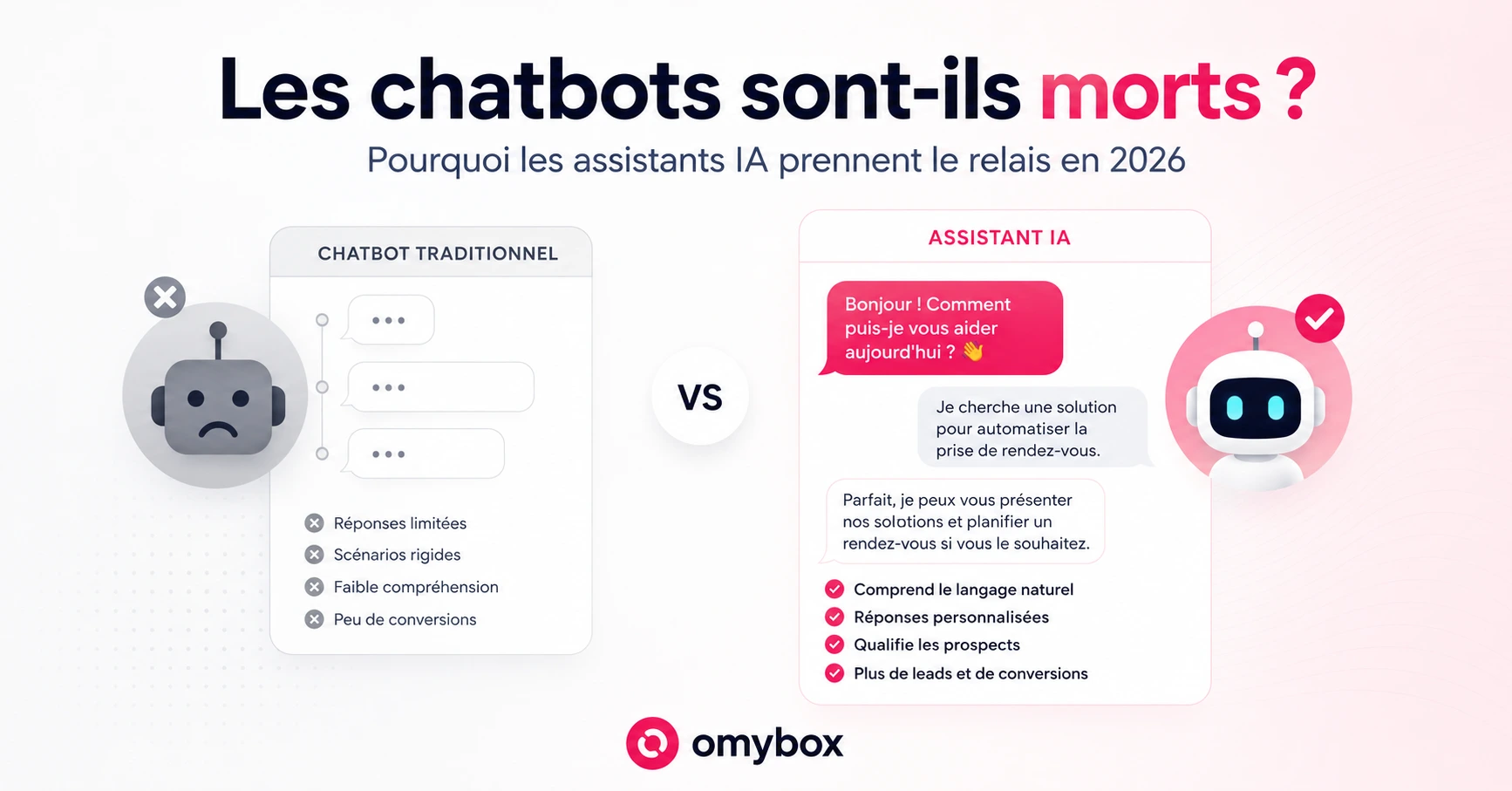
Traditional chatbot vs AI chatbot vs AI assistant
Traditional chatbot
AI assistant
Pre-programmed answers
Understands natural language thanks to language models
Decision trees
Analyses the context and the situation using LLMs
Limited questions
Personalised answers depending on the models used, but sometimes wrong and convincing without safeguards
Not very flexible
Learns from your website
Not very conversion-focused
Generates leads and appointments
The difference is comparable to that between an automatic answering machine and a genuine conversation.
Why AI assistants are gradually replacing chatbots
Businesses today are looking to improve two indicators:
their conversion rate;
their quality of service.
AI assistants built on advanced language models meet both of these goals.
They can:
respond instantly to visitors for customer support;
present your services via an AI chatbot;
qualify prospects within your workflows;
offer appointment booking to speed up sales work;
connect to APIs to pass information to your CRM and carry out more complex tasks.
This autonomy makes them more useful, but it also increases the risks when something goes wrong.
These systems use machine learning to understand questions and advanced language models to produce more natural conversations, which makes them a genuine working tool.
They become a true digital colleague in the service of productivity.
The benefits of an AI assistant
Instant answers
Visitors get an answer in a few seconds, but speed is no longer enough: the answer must also be reliable, verifiable and, increasingly, cite its sources, with the option to ask for more details.
Available 24/7
Your business stays accessible even outside office hours.
More leads
Every conversation becomes a sales opportunity.
A better user experience for customer support
Visitors quickly find the information they're looking for thanks to an effective user interface, which is key to them actually adopting the assistant, especially as 91% of customer service leaders are under pressure to implement AI faster. A good customer support experience should also offer simple access to a human agent, since 87% of customers believe a business should provide that option.
Simple integration: a concrete use case
Modern AI assistants can be set up in just a few minutes on WordPress, Shopify, WooCommerce, Wix, Webflow and most websites. A simple integration also lets you connect other tools, depending on the use case.
Do chatbots still have a purpose?
Yes.
Simple chatbots are still suitable for certain very specific uses:
answering a basic FAQ;
directing visitors to a service;
automating a few repetitive tasks.
For simple, repetitive requests, this kind of automation is one of the cases where a simple chatbot still makes sense, as the running costs of an AI chatbot are generally lower than those of systematic human handling.
But as soon as it comes to understanding visitors' intentions or generating more conversions, an AI assistant becomes far more effective, especially if the use case calls for a tool that can bring all conversations together in one place across several channels, not just on the website. Integration with different communication channels has, moreover, become essential.
Why Omybox is different
Omybox is not a conventional chatbot.
In 2026, 78% of businesses use AI and 78% of businesses use AI chatbots, which confirms that market demand is moving towards assistants that are more useful and better integrated.
It is an AI assistant designed to turn more visitors into prospects. Yes. The right choice depends above all on the use case you are aiming for.
Thanks to artificial intelligence, Omybox automatically understands the content of your website, finds the useful information within the site's text and answers questions naturally in chats or via messages, with replies tailored to your company's style and features that are useful for every business and its team.
It can also:
qualify visitors;
offer appointment booking;
capture leads;
sync information with your CRM.
All without creating complex scenarios.
The future belongs to AI assistants
Chatbots paved the way.
AI assistants go much further. In 2026, ChatGPT reached 190 million daily users, which shows just how well established these uses have become.
They allow businesses to offer a modern, personalised and far more effective conversational experience, taking into account context, the web and more advanced research needs.
In the professional world, they are no longer only used to answer questions, but also to take action as a genuine action-oriented research companion. Their widespread use also raises the question of the environmental impact of chatbots, both economic and ecological.
Tomorrow, visitors will no longer simply want to chat with a chatbot.
They will want to talk with an artificial intelligence that can genuinely understand them, is available 24/7, and is regularly tested and improved to stay effective, while keeping human oversight firmly in hand despite its growing autonomy.
Conclusion
Chatbots are not dead.
They are evolving.
Businesses that want to improve their customer experience, generate more leads and increase their conversions are now turning to AI assistants.
With Omybox, your website does more than simply answer automatically.
It understands your visitors, guides them along their journey and turns every conversation into a sales opportunity.
SEO / AEO FAQ
Are chatbots still useful in 2026?
Yes, but mainly for simple scenarios. In 2026, their usefulness also depends on a clearer framework: the AI Act requires users to be informed when they are interacting with an AI, including through the terms or conditions of use. AI assistants offer a more natural and more effective experience.
What is the difference between a chatbot and an AI assistant?
A conventional chatbot follows predefined scripts. An AI assistant understands natural language, analyses context, can produce more contextualised answers and handle certain tasks, whereas a conventional chatbot remains limited to closed scenarios.
Are AI assistants replacing chatbots?
Gradually, yes. AI assistants offer greater flexibility, a better understanding of visitors and a higher conversion rate. This replacement is progressing mainly because these tools integrate better with teams' workflows and productivity.
Why are businesses replacing their chatbots?
Because they want to improve the user experience, generate more leads and answer visitors' questions more effectively. They are also looking for a tool that can handle more context, make better use of search and automate certain tasks.
Is an AI assistant more effective than a chatbot?
In most cases, yes. It understands visitors' intentions, provides more relevant answers, can also give more detail and guide users through to getting in touch, although AI Chat can make mistakes and therefore deserves a review on sensitive points.
Is Omybox a chatbot?
Omybox is an AI assistant. Unlike a traditional chatbot, it automatically understands the content of your website and responds intelligently to visitors. For certain uses, it can also act as a writing assistant for operational content, such as reports or emails, if these features are enabled.
Can an AI assistant generate more leads?
Yes. By answering questions instantly, qualifying prospects and offering appointment booking, an AI assistant helps to boost conversions. It can also help marketing teams produce blog posts, stories or other creative writing formats, with more advanced features in premium or pro versions depending on the tool. It can likewise assist writers with drafts of essays or the preparation of related images, depending on how it's used.
Go further
Further resources, chosen for this topic.
AI assistant for dental clinics
A complete example: patient questions, emergencies and appointment booking.
Omybox or Chatbase: the differences
Automated answers from your own data
Omybox plans and pricing
Find the plan that fits your visitor volume.
Omybox help centre
Installation, personalisation and conversation tracking.