
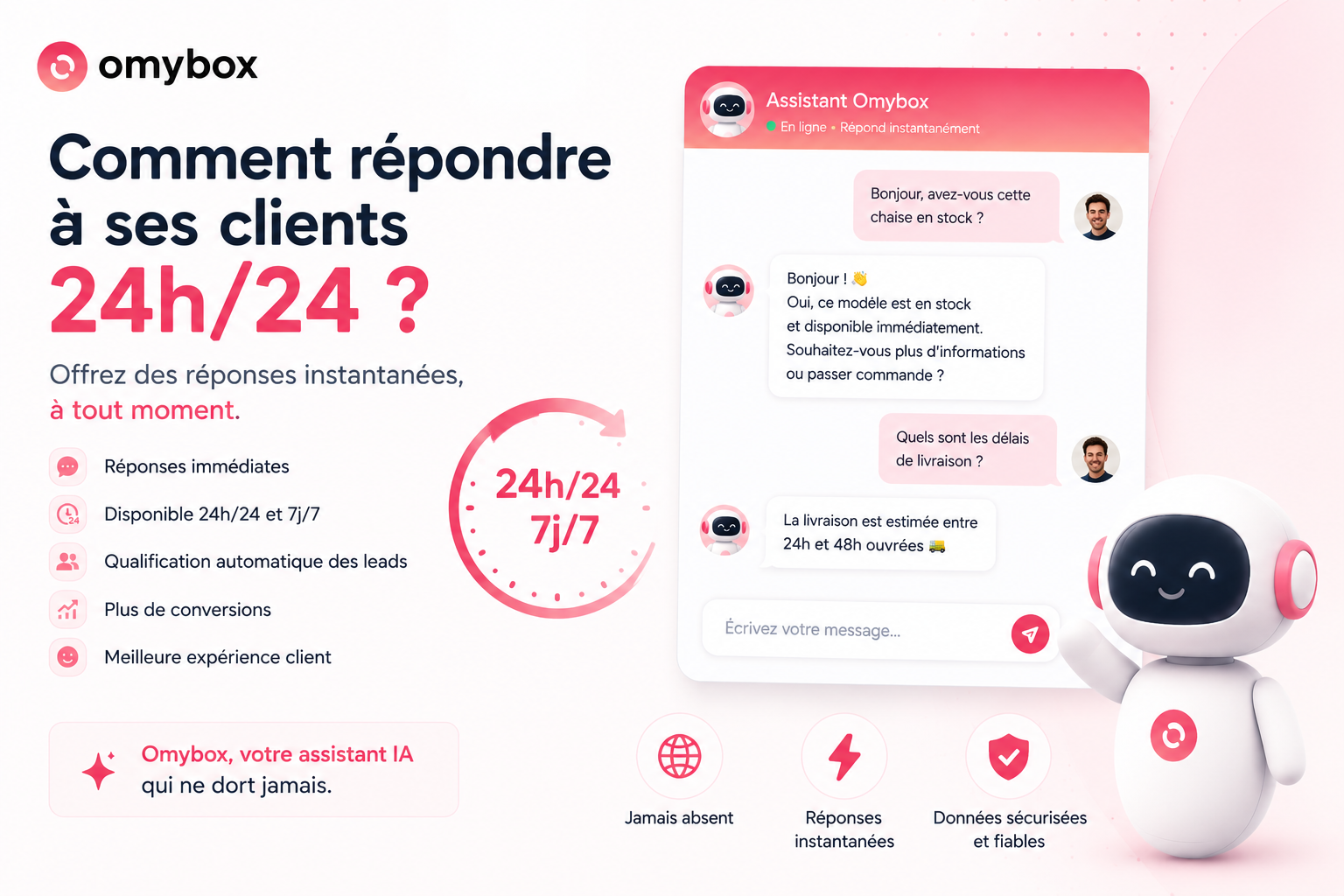
How to answer your customers 24/7 in 2026?
Introduction: Today, customers no longer want to wait.
Whether it's 10am, 10pm or a Sunday, visitors now expect instant answers when they contact a business.
For many SMEs and e-commerce businesses, this is becoming a real challenge.
How can you respond quickly without a support team available 24/7? How do you avoid losing prospects outside office hours? How can you improve the customer experience without costs spiralling?
With the rapid arrival of accessible, modern conversational AI assistants, a concrete solution to this problem is emerging for 2026. Yet only 13% of micro and small businesses use artificial intelligence solutions, according to the France Num 2024 Barometer.
Why customers want instant answers
Consumer habits have changed profoundly.
Today, users are used to:
instant messaging,
real-time replies,
AI assistants,
and smooth experiences available at any time.
When a visitor arrives on a website with a question, they usually want:
✔️ a quick answer, which brings many benefits for the business, notably by boosting customer satisfaction,
✔️ clear information,
✔️ and immediate support.
Responding quickly doesn't only benefit the customer: it also improves team productivity by automating the handling of requests and optimising support efficiency.
The problem?
Many businesses still reply:
several hours later,
the next day,
or sometimes never.
And in the meantime, the prospect:
❌ loses interest,
❌ leaves the site,
❌ or contacts a competitor.
SMEs can't have a team available 24/7
For a large company, it is sometimes possible to set up permanent customer support.
But for the majority of SMEs, this model remains difficult:
high cost,
lack of resources,
limited team,
restricted opening hours.
Result:
many opportunities are lost simply because no reply is given at the right time.
This is precisely what is now pushing many businesses to adopt AI assistants.
AI assistants are changing the customer relationship
Modern AI assistants, powered by advanced intelligence, can now automatically answer visitors 24/7.
Unlike older chatbots limited to a handful of pre-programmed replies, new solutions based on artificial intelligence understand natural language and maintain a coherent conversation. The AI assistant draws on existing data to generate accurate, consistent content, thereby reducing the risk of human error when handling repetitive data.
An AI assistant can:
✔️ answer frequently asked questions instantly,
✔️ guide visitors,
✔️ automatically qualify requests,
✔️ recommend services or products,
✔️ collect important information,
✔️ and pass leads on to the team.
By automating these varied tasks, AI assistants save professionals several hours a week.
All of it, automatically.
Why answering quickly improves conversions
Response time has a direct impact on revenue.
When a visitor gets an immediate answer thanks to the advanced features of AI assistants, such as automated replies or integration with other tools:
they stay on the site longer,
they engage more,
they feel supported,
and they are far more likely to convert.
Conversely, when no answer is available:
frustration grows,
the abandonment rate soars,
and opportunities vanish.
Today, the speed of response offered by these features represents a genuine competitive advantage.
Tools to automate replies
To offer a customer service available 24/7, businesses now rely on a new generation of automation tools. Powered by artificial intelligence, these solutions analyse customers' questions in real time and generate personalised answers, whichever channel is used.
Intelligent chatbots are at the heart of this revolution. Built directly into websites, mobile apps or social networks, they can handle a large volume of enquiries without tying up a human team around the clock. Thanks to AI, these assistants understand natural language, tailor their answers to the context and guide customers towards the most relevant solution.
But automation doesn't stop there. Many tools can also send automated e-mails or messages, whether to acknowledge a request, follow up with a prospect or update someone on the progress of their file. This intelligent handling of communications improves the quality of customer service while freeing up time for your teams.
For businesses, the challenge is twofold: deliver a smooth, responsive customer experience while optimising how resources are managed. Automated response tools are therefore becoming an essential pillar for meeting customer expectations in 2026.
Social media: a key channel for round-the-clock availability
Social networks have become a privileged point of contact between businesses and their customers. Today, most consumers no longer hesitate to ask their questions, share their opinions or seek help directly on Facebook, Instagram, X (formerly Twitter) or LinkedIn. For businesses, being present and responsive on these platforms has become essential to maintaining a modern, approachable brand image.
Round-the-clock availability on social media is no longer an option: it's a strong expectation from customers. Thanks to automation tools, it is now possible to manage conversations efficiently, reply instantly to frequently asked questions and handle private messages at any hour. AI assistants analyse the content of messages, suggest suitable replies and can even route complex requests to a human agent.
Beyond customer support, social media is also a powerful lever for promoting your products, sharing content and strengthening customer loyalty. Automation tools make it possible to schedule posts, track interactions and maintain a continuous presence, even outside office hours.
In 2026, intelligent social media management, powered by AI, is a major asset for ensuring availability and customer satisfaction, while optimising the efficiency of your teams.
Omybox: an AI assistant designed to answer 24/7
It is precisely to help SMEs and e-commerce businesses respond to their customers at any time that Omybox was created.
Omybox is a conversational AI assistant available as an application, designed to work across different connected devices, including phones, tablets and computers. This personal assistant offers a personalised experience to each user by being able to:
answer visitors automatically,
understand prospects' needs,
qualify leads,
and improve the customer experience 24/7.
The goal is not simply to automate replies.
The goal is to turn a website into a genuine sales assistant capable of interacting intelligently with visitors, accessible from any device, including your phone, for centralised and personalised management.
How Omybox helps businesses in practice
Instant answers
Visitors get answers straight away, even outside office hours.
Automatic lead qualification
The assistant can ask smart questions to identify a prospect's needs, while recognising people you interact with regularly to offer a more personalised experience.
Time savings
Your teams spend less time answering repetitive questions.
Better user experience
Visitors feel supported and quickly find the information they're looking for, including through the ability to create or manage a list of tasks, reminders or events via the AI assistant.
More conversions
Fewer visitors leave the site without interacting, as the AI assistant can automate appointment booking, making it easier to turn prospects into customers.
Do AI assistants replace humans?
No.
An AI assistant does not replace a human team.
It is essential to clearly define the role of the AI assistant within the organisation, so as to clarify its responsibilities, its limits and its expected behaviour.
Above all, it allows you to:
handle simple requests,
automate repetitive tasks,
and filter requests before passing them on to your teams.
Your colleagues can then focus on:
complex requests,
sales,
and high-value interactions.
AI becomes a tool to assist, not a complete replacement.
Why businesses are increasingly adopting conversational AI
Businesses are gradually realising that a website should no longer be passive.
Today, a high-performing website must:
✔️ respond,
✔️ support,
✔️ guide,
✔️ and convert.
AI assistants such as ChatGPT, Gemini or Microsoft Copilot make this possible precisely thanks to regular updates that continuously improve their features. Each of these developments helps optimise the user experience and strengthen the reliability of the service. Integration with Google and Google Workspace makes collaboration and task automation easier, while managing pricing, generating marketing content and answering complex questions become available around the clock.
AI assistants turn a simple showcase website into a genuine interaction tool that is available at all times. They can produce multilingual summaries, extract action items to make meetings more efficient, analyse data to offer personalised suggestions, automate e-mail management (drafting, appointment booking, information retrieval), and interact via text or voice. Thanks to their understanding of natural language, they make interaction easier, reduce human error by producing consistent and accurate content, and deliver an excellent customer experience.
Cost and investment: what's the return for SMEs?
Adopting an AI assistant or automation tools is a strategic investment for SMEs. While the upfront cost may seem significant, it needs to be weighed against the tangible benefits generated day to day.
Firstly, automation significantly reduces the time spent on repetitive tasks, such as handling frequently asked questions or sending follow-up messages. This leads to lower operating costs and better allocation of human resources to higher-value work.
Secondly, the increased responsiveness offered by AI improves customer satisfaction, which encourages loyalty and raises conversion rates. Many businesses see revenue growth thanks to better lead management and an optimised customer experience.
Finally, AI assistant solutions are now affordable, with pricing models suited to SMEs: monthly subscriptions, pay-as-you-go or gradual integration based on needs. Return on investment can be seen quickly, notably through a lower drop-off rate, higher sales and an enhanced brand image.
For SMEs, investing in automated customer service is no longer a luxury but a key step in staying competitive and meeting market expectations in 2026.
Conclusion
Responding to customers 24/7 has become a major challenge for SMEs and e-commerce businesses.
Visitors want:
immediate answers,
a smooth experience,
and simple support.
Without this, opportunities vanish quickly.
AI assistants such as Omybox offer many advantages: they let businesses automatically respond to visitors, qualify prospects, improve the customer experience and convert more traffic into customers.
Take advantage of a free trial to test an AI assistant and discover all the benefits of automation for yourself.
Because in 2026, the businesses that respond fastest are often the ones that convert best.
Go further
Further resources, chosen for this topic.
AI assistant for dental clinics
A complete example: patient questions, emergencies and appointment booking.
Omybox or Chatbase: the differences
Automated answers from your own data
Omybox plans and pricing
Find the plan that fits your visitor volume.
Omybox help centre
Installation, personalisation and conversation tracking.