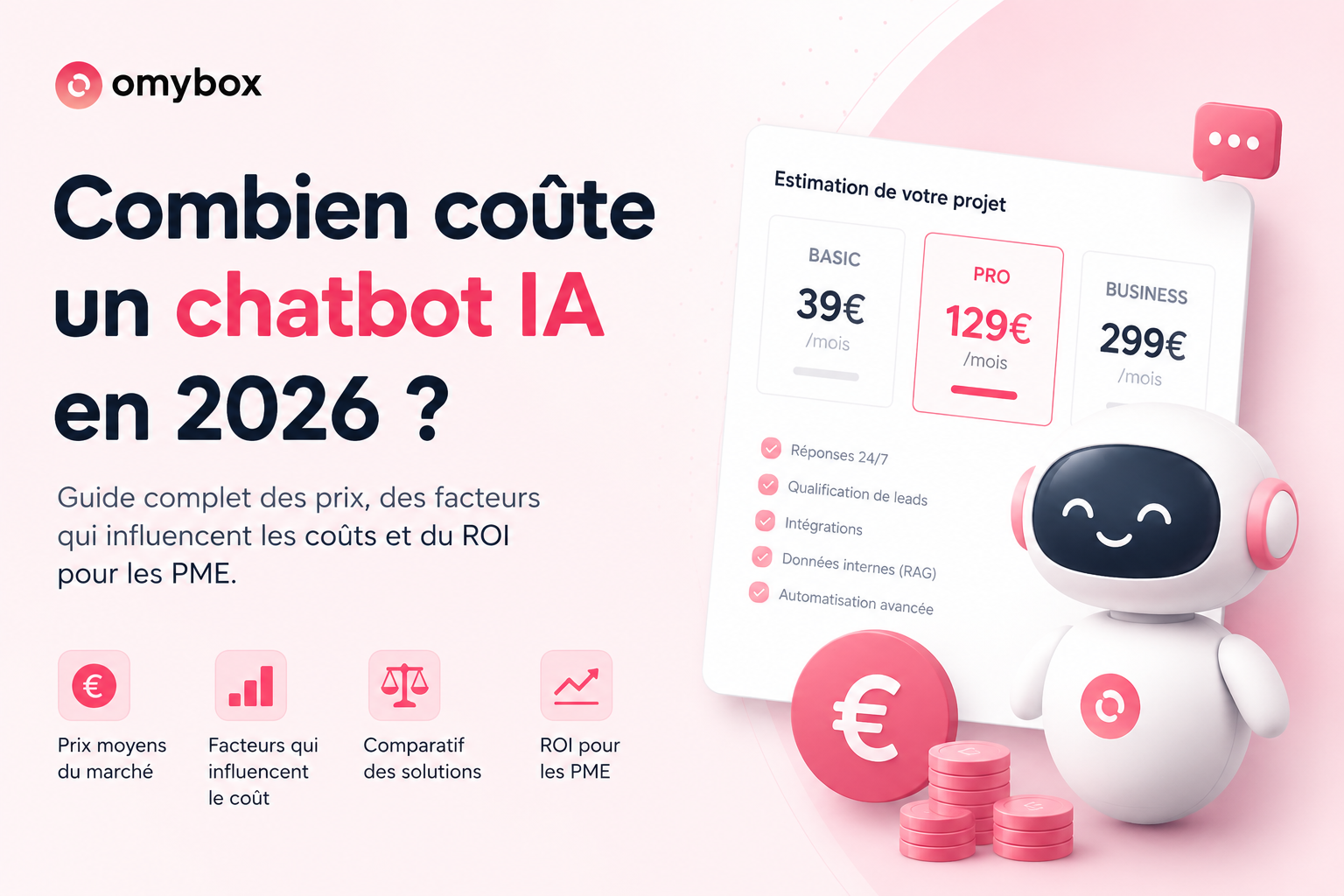
AI chatbot pricing varies enormously: an SMB can test an online tool for free, or invest tens of thousands of euros in a fully bespoke project. So the right question isn't just "how much does a chatbot cost?", but "what level of features, support and ROI do I need right now?"
Key takeaways
A bespoke AI chatbot often costs between €10,000 and €50,000, and can go beyond that if the technical complexity includes RAG, multi-agent setups or heavy integrations.
A No-Code SaaS solution starts at €0 / month; OmyBox offers a free plan, then paid rates from €19 / month incl. VAT.
The cost depends mainly on conversation volume, the level of artificial intelligence, natural language, integrations and maintenance.
For an SMB, the value comes from 24/7 support, time savings, prospect qualification and a better user experience.
It is rarely necessary to spend €30,000 right from the start of a chatbot: a platform like OmyBox lets you start small and grow from there.

What is an AI chatbot and why do SMBs need one?
What is an AI chatbot? What exactly is a chatbot? It is a computer programme designed to automate communication with users, whether by text or voice, on a chat, a website, an e-mail, an app or a messaging service. Thanks to advanced technologies such as natural language processing (NLP) and artificial intelligence (AI), a chatbot simulates human conversations and automates interactions, which helps optimise customer service, lead qualification and sales.
The main function of a basic chatbot relies on a menu, buttons and keywords, following fixed scripts: opening hours, address, prices, availability. An AI chatbot goes further: it understands natural language, keeps track of the context of a conversation and can provide more relevant answers, even if the user phrases their request differently.
For an SMB, chatbot use covers several common use cases:
customer service on websites;
appointment booking;
lead qualification;
product FAQs available 24/7;
handover to a human advisor if the bot can't answer.
A chatbot's effectiveness and profitability come from certain features or strategies tailored to each business. Chatbots improve the customer experience by being available 24/7, offering instant answers and a smooth journey, which increases customer satisfaction and loyalty. At timeOS, we see the same effect with meeting assistants: when AI automates repetitive tasks, teams can focus on high-value work.
The main types of chatbots and their impact on price
There are three technological generations of chatbots, each with different capabilities and costs, ranging from basic chatbots to intelligent chatbots built on advanced AI. The type you choose directly influences the price.
Basic conversational chatbots rely on predefined scripts using keyword analysis and are used to handle simple interactions such as answering questions or suggesting opening hours. Their cost is low, but their flexibility remains limited.
Multi-conversation chatbots have a better semantic analysis engine, allowing them to understand requests that include context and synonyms, and to trigger complex actions. They are better suited to SMBs with an active customer support function.
Business chatbots are designed to automate specific processes within a company, whether internal or external, and require advanced technologies such as natural language understanding. They can create a ticket, look up a CRM or trigger a business workflow.
Personal assistants, often called voicebots, are designed to understand spoken language and carry out simple actions, requiring robust API connections. They are useful in voice applications or call centres.
Media chatbots are used to distribute content on messaging platforms and require simple technology to detect keywords and manage content.
Chatbots can therefore be classified into different categories, notably business chatbots, personal assistants and media chatbots, each with specific technologies and applications.
Open source solutions such as Rasa or Botpress sometimes reduce the licence cost, but they require developers, hosting, security and updates. For an SME, the best cost-to-value ratio is often a ready-to-use SaaS AI chatbot platform such as OmyBox.
Key factors that influence the price of an AI chatbot
Here are the key factors to analyse before building a chatbot.
Functional complexity: a simple FAQ costs far less than a chatbot connected to a CRM, a payment system, a ticketing tool or an ERP.
Level of artificial intelligence: the technologies used to develop a chatbot, such as artificial intelligence and natural language processing, also influence the final cost, as more advanced technologies require more expensive infrastructure and APIs.
Models used: an agent based on ChatGPT, GPT-4o, Claude, ChatGPT Plus or Claude Pro does not cost the same depending on volume, credits consumed and quality requirements.
Implementation and integrations: connecting a widget to WordPress or Shopify is simple; connecting the chatbot to a standard CRM adds between €1,500 and €5,000 to the project. Integrations with WhatsApp, Facebook Messenger, Slack, social networks or internal tools also increase the bill.
Technical complexity: the technical complexity of a conversational agent can drive up costs, especially for those integrating RAG searches or multi-agent setups.
Regulation: strict regulatory requirements can raise the initial development cost by 30% to 80% to guarantee data security.
Maintenance: the cost of maintaining and retraining the AI should be budgeted at between 10% and 20% of the initial cost per year. Maintaining a chatbot is crucial throughout its life, requiring regular monitoring to adjust its performance and ensure it answers users' questions correctly.
Recurring costs: businesses face significant ongoing operating costs once chatbots go live, including APIs, hosting, logs, monitoring and support.
How much does an AI chatbot really cost in 2026?
Prices differ depending on whether you opt for a standardised online platform, a No-Code SaaS, or custom development. The type of development chosen, whether through a SaaS platform or bespoke build, has a significant impact on cost, with custom solutions generally being more expensive due to their personalisation and flexibility.
In 2026, the cost of an AI chatbot can range from €0/month for a basic SaaS solution to more than €50,000 for a complex custom build. More broadly, the price of an AI-based chatbot solution varies from €20/month to over €100,000 for a bespoke project, depending on technical complexity, integrations with the information system and conversation volumes.
Useful orders of magnitude:
Simple chatbot: between €1,000 and €5,000 for a light build, often limited to an FAQ or a script.
Advanced AI chatbot: between €15,000 and more than €50,000 for design, development, integrations, infrastructure and testing.
SaaS platform: from €0 to €500/month depending on the plan, number of messages, features and support.
AI usage cost: processing a request with a high-performing AI chatbot costs between €0.20 and €0.80 per conversation.
LLM API: fees for Large Language Models (LLMs) range from €50 to €500/month depending on how intensively they are used.
Software publishers typically use three distinct billing methods. Billing based on the number of messages sent or the volume of tokens consumed is a common approach. A fixed subscription plan sets a stable monthly price based on the number of human agents or workspaces. Performance-based billing only requires payment when the AI has successfully resolved the conversation.
Some SME profiles:
Local micro-business: a few hundred interactions per month, simple FAQ, free plan or €19/month.
E-commerce SME: several thousand interactions, order tracking, leads, marketing, plan at €49 to €150/month.
B2B scale-up: multichannel, CRM, automations, several projects, advanced SaaS or bespoke budget.
OmyBox pricing plans: prices designed for SMEs
OmyBox stands out with clear pricing: you can start for free, then move up a tier only when your needs grow.
OmyBox Free plan: €0/month, ideal for trying out building a chatbot without a bank card, with a reasonable volume of conversations for a showcase website. It's perfect for validating an idea before you invest.
OmyBox Essential plan: €19/month incl. VAT. It suits small SMEs and includes 1 AI chatbot, website integration, a knowledge base with FAQs and PDFs, and simple statistics.
OmyBox Pro plan: around €49 / month. It targets growing SMEs with several chatbots, higher message volumes, basic CRM integrations, advanced widget customisation and better visibility over prospects.
OmyBox Business plan: for example €99 / month depending on volume and options. It is designed for structured support teams with multichannel, WhatsApp, Messenger, SSO, advanced analytics and priority support.
All plans include regular AI updates, continuous improvement of natural language understanding and secure hosting in Europe. Access is designed for SMEs: no need for a technical team, a permanent freelancer or in-house developers to get set up.

How much can an OmyBox chatbot save you?
A chatbot can cut operating costs by 40 to 60% by automating around 70% of support requests, so the initial investment pays for itself quickly. In practice, a well-configured AI chatbot often automates between 50% and 70% of recurring questions: opening hours, order tracking, prices, availability, appointment booking.
Let's take a simple case. An SME receives 600 questions a month. If each question takes 5 minutes of human work, that amounts to 3,000 minutes, or 50 hours. At €20 / hour, the internal cost reaches €1,000 a month. In this context, an OmyBox subscription at €19 or €49 / month can pay for itself within a few days of use.
ROI doesn't come from support alone. A high-performing chatbot can raise conversion rates by 15 to 50% by qualifying prospects, closing sales and automatically following up with customers. Chatbots also collect valuable data and insights into customer behaviour, which helps improve offers and marketing strategies.
How to choose the right AI chatbot plan for your SME
Before you build anything, don't start with the price alone. Start with your needs.
Define your use cases. To ensure an optimal customer experience, it is essential to define a chatbot's use cases before creating it, so it doesn't end up as a simple FAQ tool.
Estimate your volume. Count the monthly conversations across your website, your email, your social networks and your support.
Check how easy it is to implement. A no-code interface, a copy-and-paste script and quick integration on websites greatly reduce the cost.
Analyse the AI features. Look at how well it understands French, context, models, usable data and automatic updates.
Test before rolling out widely. Setting up a chatbot means programming the range of possible questions and answers, and involves testing phases with your teams to make sure it works.
If you're torn between two plans, start with the OmyBox free plan, then move to €19 once usage becomes regular. That is often wiser than launching an expensive bespoke project straight away.
FAQ on the price of AI chatbots for SMEs
Is a free AI chatbot enough for an SME?
Yes, if you want to test the concept, measure traffic and identify the most frequent questions. A free plan such as the starter offer from OmyBox suits a showcase website or a first experiment. Once volume grows or you need CRM, WhatsApp integrations or business-specific scenarios, the €19 plan becomes more relevant.
What is the price difference between an open source chatbot and an OmyBox solution?
An open source solution doesn't necessarily charge a licence fee, but it requires internal hosting, security, development, monitoring and updates. These hidden costs can reach several thousand euros a year. OmyBox offers a turnkey solution from €0, then €19 / month, with hosting, AI, support and maintenance included.
How long does it take to deploy an OmyBox chatbot?
A first simple AI chatbot, with an FAQ and a contact form, can be set up in a few hours. A more advanced setup, with CRM, complex scenarios or multichannel, usually takes a few days. The platform is designed for SMEs: interface in French, guided setup and support when needed.
Will AI chatbot prices fall or rise over time?
The raw cost of AI technology is falling, but the added value lies in features, integrations, security and answer quality. In 2026, the market is moving towards more accessible plans with more power for the same subscription. OmyBox regularly updates its models and features at no extra cost for existing customers.
What happens if my message volume exceeds my OmyBox plan?
You can move your account to a higher plan without any interruption to service. OmyBox lets SMEs know when they are approaching their limits, so there are no unpleasant surprises. Pricing stays predictable, even if your activity peaks several times over the year.
Conclusion
The right price for an AI chatbot isn't the lowest one: it's the one that matches your needs, your volume and your level of automation. For a small business, OmyBox makes access to an AI chatbot much simpler: free to get started, €19/month to take things up a level, then higher plans as your business grows.
If your goal is to save time, answer your customers better and capture more leads without launching a heavy project, start by trying OmyBox for free.
Go further
Further resources, chosen for this topic.
AI assistant for dental clinics
A complete example: patient questions, emergencies and appointment booking.
Omybox or Chatbase: the differences
Automated answers from your own data
Omybox plans and pricing
Find the plan that fits your visitor volume.
Omybox help centre
Installation, personalisation and conversation tracking.