
Customer support is evolving quickly.
Today, customers want:
immediate answers,
assistance available at any time,
and a smooth experience when they contact a business.
The problem?
Many businesses still rely on traditional customer support that:
❌ responds slowly,
❌ depends on office hours,
❌ overloads teams,
❌ and sometimes creates a poor customer experience.
In 2026, conversational AI assistants are completely changing the way businesses manage their customer relationships.
But one question comes up often:
AI assistant or traditional customer support: which solution is most effective?
The reality is that the two approaches are not necessarily opposed.
AI does not entirely replace humans.
Above all, it transforms:
response speed,
request handling,
and the overall efficiency of customer support.
How traditional customer support works
Traditional customer support typically relies on:
phone calls,
e-mails,
contact forms,
or human conversations via chat.
This model still works.
However, it has several significant limitations:
waiting times,
high staffing costs,
limited availability,
difficulty handling peaks in demand,
and the constant repetition of the same questions.
In many businesses, support teams still spend an enormous amount of time responding to:
the same requests,
the same problems,
or the same frequently asked questions.
Why customers now expect immediate answers
Consumer habits have changed.
Today, users are used to:
instant messaging,
real-time replies,
and ultra-fast platforms.
When a customer asks a question:
about a product,
an order,
a delivery time,
or a technical problem,
they no longer want to wait for hours.
Every minute of waiting increases:
❌ frustration,
❌ abandoned enquiries,
❌ and the risk of losing a customer.
Speed therefore becomes a huge competitive advantage.
What is a conversational AI assistant?
An AI assistant is a solution based on artificial intelligence that is able to:
✔️ automatically answer users,
✔️ understand natural language,
✔️ qualify requests,
✔️ automate frequent answers,
✔️ and support human teams.
Unlike older chatbots limited to fixed replies, modern AI assistants use:
natural language processing,
generative AI models,
and machine learning.
They are capable of holding a far more natural and contextual conversation.
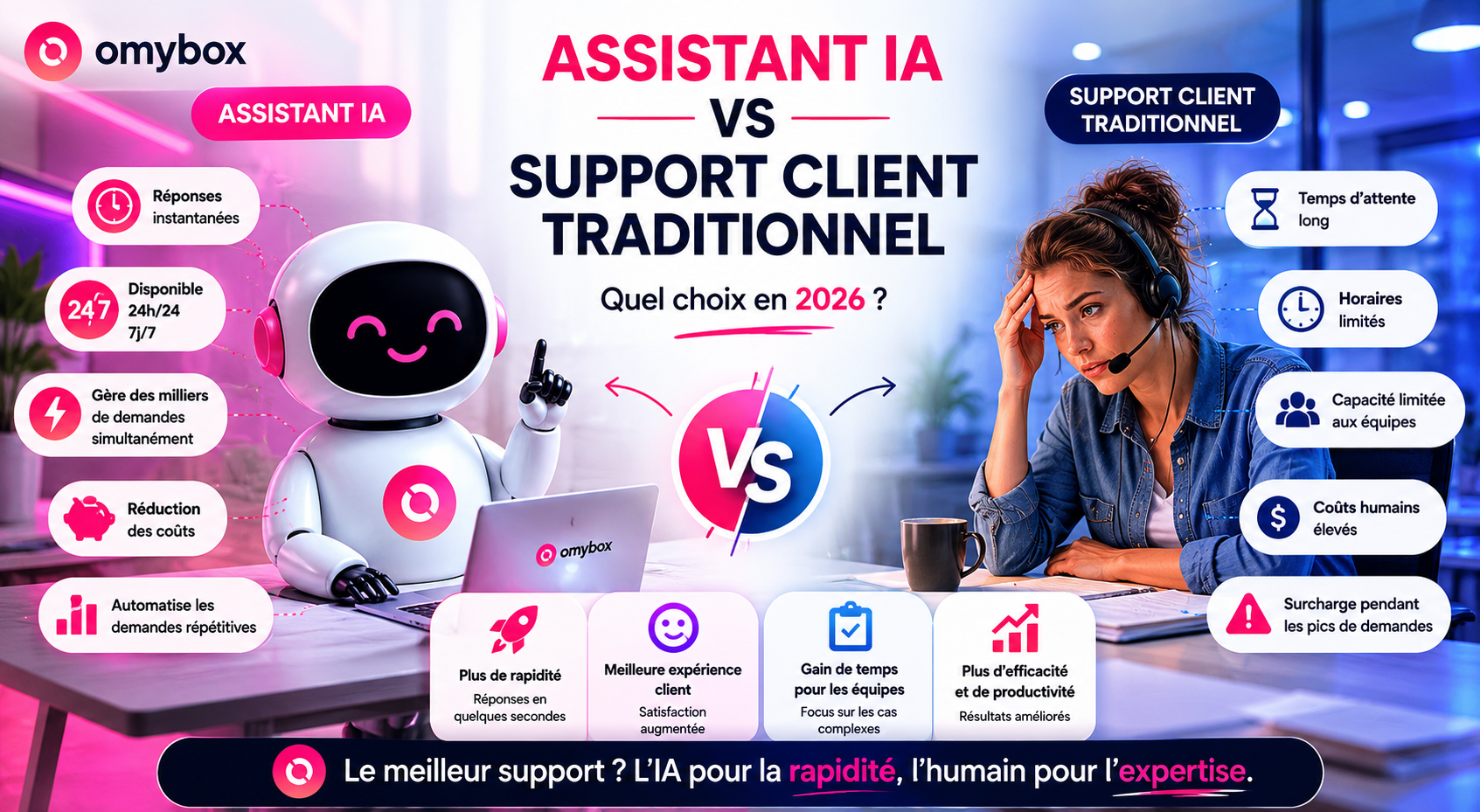
AI assistant vs traditional support: the key differences
Availability
Traditional support:
depends on opening hours,
on the teams available,
and on the workload.
AI assistant:
✔️ available 24/7,
✔️ seven days a week,
✔️ without interruption.
Response time
Traditional support:
Replies can take:
several minutes,
several hours,
or even several days.
AI assistant:
✔️ instant replies,
✔️ immediate handling of requests,
✔️ real-time assistance.
Handling volume
Traditional support:
Human teams have limited capacity.
During peaks:
waiting times soar,
tickets pile up,
and quality can drop.
AI assistant:
✔️ can handle hundreds of conversations simultaneously,
✔️ without slowing down.
Operating cost
Traditional support:
salaries,
training,
recruitment,
team management.
AI assistant:
✔️ automation of a large share of repetitive requests,
✔️ lower support costs,
✔️ better productivity.
Quality of the customer experience
Human support:
Humans remain better for:
complex situations,
emotions,
negotiation,
and sensitive cases.
AI assistant:
Excellent for:
✔️ quick replies,
✔️ simple requests,
✔️ qualification,
✔️ and immediate assistance.
Why businesses now combine AI and humans
The best approach in 2026 is not:
“AI OR humans”.
But rather:
AI + humans.
AI handles:
frequently asked questions,
simple answers,
qualification,
repetitive requests.
Human teams then focus on:
complex cases,
customer relationships,
and high-value tasks.
The result:
✔️ less overload,
✔️ a better customer experience,
✔️ faster responses,
✔️ and better productivity.
How an AI assistant genuinely improves customer support
Instant automatic replies
The AI can reply straight away to questions about:
orders,
delivery times,
returns,
products,
or services.
Qualifying requests
The assistant can:
identify the need,
collect the important details,
and pass requests on to the right teams.
Fewer repetitive tickets
AI assistants dramatically reduce:
simple requests,
repetitive questions,
and time-consuming tasks.
Round-the-clock availability
Even:
in the evening,
at weekends,
or during holidays.
Support stays active.
Omybox: an AI assistant designed to improve customer support
Omybox was created precisely to address these challenges.
Omybox is a conversational AI assistant designed to help businesses:
✔️ answer visitors instantly,
✔️ automate repetitive requests,
✔️ improve customer satisfaction,
✔️ qualify requests automatically,
✔️ and optimise the work of support teams.
Unlike old, rigid chatbots, Omybox understands natural language and keeps the conversation flowing smoothly.
The assistant can be trained using:
your website,
FAQs,
internal documents,
procedures,
and your company content.
Will AI replace support teams?
No.
AI does not replace:
the human connection,
sensitive situations,
or complex exchanges.
Above all, it helps to:
✔️ speed things up,
✔️ automate repetitive tasks,
✔️ reduce the load on teams,
✔️ and increase the efficiency of customer support.
The benefits of an AI assistant for customer support
✔️ Instant replies
✔️ Available 24/7
✔️ Shorter response times
✔️ Fewer repetitive tickets
✔️ Time saved for teams
✔️ Higher customer satisfaction
✔️ Lower operating costs
✔️ A better user experience
FAQ – AI assistant vs traditional customer support
Can an AI assistant completely replace human customer support?
No. AI mainly automates repetitive requests and improves response speed. Human teams remain essential for complex situations and customer relationships.
What are the benefits of an AI assistant for customer support?
An AI assistant replies instantly, shortens delays, automates repetitive requests and improves the customer experience, while reducing the load on teams.
Why are businesses adopting AI assistants?
Because customers now expect immediate answers and support available at any time.
Can an AI assistant work 24/7?
Yes. Conversational AI assistants remain available 24/7 without interruption.
What is Omybox's role in customer support?
Omybox helps businesses automate conversations, improve their responsiveness and optimise their customer support through conversational artificial intelligence.
Conclusion
In 2026, businesses need to be able to respond quickly to their customers.
Users want:
immediate answers,
smooth support,
and a simple experience.
Traditional customer support remains important.
But AI assistants such as Omybox now make it possible to:
✔️ automate replies,
✔️ improve responsiveness,
✔️ reduce the load on teams,
✔️ and deliver a better customer experience.
Because today, the fastest businesses are often those that build the strongest customer loyalty.
Go further
Further resources, chosen for this topic.
AI assistant for dental clinics
A complete example: patient questions, emergencies and appointment booking.
Omybox or Chatbase: the differences
Automated answers from your own data
Omybox plans and pricing
Find the plan that fits your visitor volume.
Omybox help centre
Installation, personalisation and conversation tracking.