
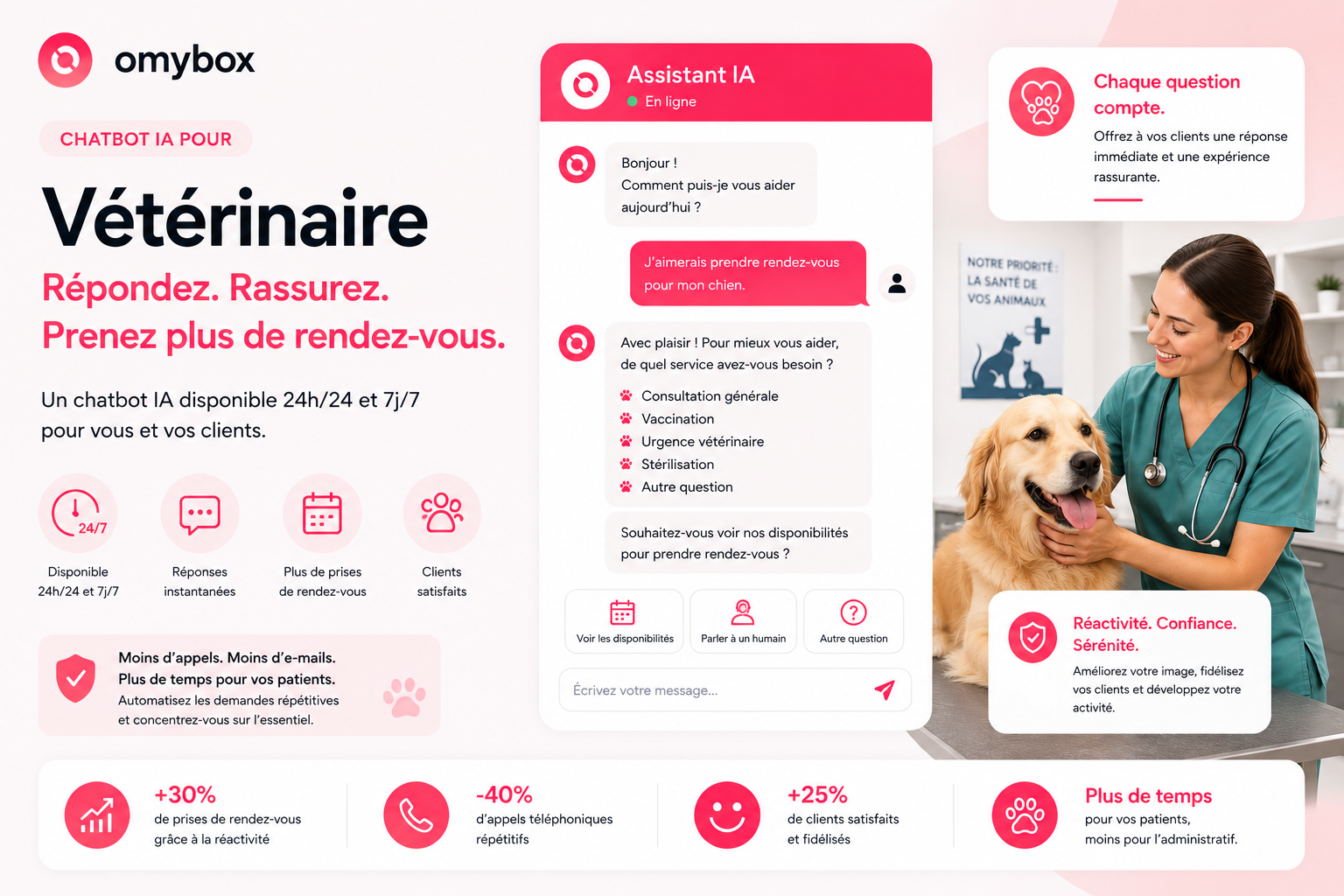
AI chatbot for vets: why veterinary clinics are adopting it in 2026
The veterinary sector is evolving rapidly.
Today, pet owners want:
instant answers,
simple appointment booking,
and quick communication with their veterinary clinic.
The problem?
Many veterinary practices still lose potential customers simply because:
❌ calls go unanswered,
❌ enquiries arrive outside opening hours,
❌ or visitors leave the site without interacting.
In 2026, conversational AI chatbots are becoming a genuine lever for improving the customer experience and optimising how enquiries are handled in veterinary clinics.
Why veterinary clinics lose customers
When a pet owner looks for a vet:
they may have an emergency,
a worry,
or simply need a quick answer.
The visitor is usually looking for:
✔️ information on care,
✔️ availability,
✔️ veterinary emergencies,
✔️ prices,
✔️ or appointment booking.
But in many cases:
the clinic is closed,
the phone lines are busy,
or no immediate assistance is available.
The result: the owner contacts another veterinary clinic, whereas an AI chatbot, powered by artificial intelligence, can keep the conversation going, improve how enquiries are understood, offer useful guidance, strengthen responsiveness and lighten the customer service workload, with artificial intelligence designed to boost team productivity too, including through an AI chat.
Contact forms are no longer enough
For a long time, veterinary practices have relied on:
forms,
phone calls,
or emails.
But customer habits have changed.
Today, visitors want:
✔️ an instant response,
✔️ a smooth interaction,
✔️ and quick contact.
The visitor is usually looking for: a quick answer, first-level advice and more effective guidance, including from an app or a mobile app connected to their everyday tools.
Traditional forms often create:
❌ too much waiting,
❌ too much friction,
❌ and too many abandoned enquiries.
In a sector as competitive as veterinary care, every customer counts. Without an immediate service, the clinic loses the advantage that a modern AI chatbot offers, one that, thanks to natural language processing, can understand context, handle complex enquiries and improve the customer experience with instant replies. Its features also allow for more personalised responses than a traditional system.
Why responsiveness is essential in the veterinary sector
When a pet owner looks for a vet:
they may be stressed,
worried about their animal,
or in an urgent situation.
The first contact directly influences:
✔️ trust,
✔️ the clinic's image,
✔️ and the chances of an appointment being booked.
A clinic that can respond quickly immediately projects an image of being:
more modern,
more reassuring,
and more professional.
It can also provide initial support with simple advice, although a chatbot's ability to handle a very emotional situation remains limited. Traditional forms often create friction. More interactive tools better meet today's expectations, as customers have grown used to getting quick answers via SMS, WhatsApp, email, a website, an app or a mobile app.
What is an AI chatbot for vets?
A veterinary AI chatbot is a conversational assistant able to:
✔️ automatically answer visitors and provide initial informational support to a worried pet owner,
✔️ understand enquiries,
✔️ qualify customers,
✔️ help with appointment booking,
✔️ and improve the user experience through useful features.
Unlike older chatbots limited to a handful of fixed replies, modern AI assistants rely on artificial intelligence, a better understanding of natural language, analytics tools, a business database and contextual data to produce more relevant output, including the generation of replies in a smooth AI chat.
First contact directly shapes how the practice is perceived. The bot can also offer simple advice, but its solutions remain limited in sensitive situations, whereas the AI assistant never replaces a veterinary opinion.
The aim is not to replace vets.
The aim is to improve:
responsiveness,
request management,
and the customer experience.
How an AI assistant practically helps a veterinary clinic
Answering visitors 24/7
Visitors can ask their questions:
in the evening,
at the weekend,
or when the clinic is closed.
The AI chatbot remains available at all times.
Automatic qualification of requests
The assistant can ask questions in order to:
understand the customer's need,
identify an emergency,
capture the important information in the data,
and pass requests on to the clinic via an integration with its database.
The AI chatbot remains available at all times. It also provides instant customer service, with replies tailored to the visitor's request. Depending on how it is updated, it can guide decision-making and distribute requests between different agents.
Reducing repetitive calls to save time
Veterinary clinics constantly receive the same questions:
opening hours,
emergencies,
vaccinations,
treatments,
prices,
availability,
appointment booking.
An AI chatbot can automate a large share of these exchanges. Connected to a CRM or a database, it personalises qualification and offers more relevant replies in real time. This automation reduces the processing load, eases the team's workload and stops the phone from monopolising reception. To remain reliable, the information gathered must also be updated regularly so that replies stay accurate. Machine learning algorithms can also analyse user behaviour to refine conversations and strengthen engagement. Among the most useful solutions, some agents can even automatically route each request to the right handling process to support decision-making.
More appointments booked
Many visitors leave a veterinary website without contacting the clinic, while repeated calls also weigh on the phone team's workload. An AI chatbot makes the difference against a passive site by starting the conversation, suggesting care options based on the request and directing visitors to the right service more quickly.
An AI chatbot allows you to:
✔️ automatically start the conversation,
✔️ reassure visitors,
✔️ and increase appointment requests while automating simple enquiries to free up the team for other tasks.
Omybox: an AI chatbot designed for vets
This is exactly what Omybox was created to address.
Unlike a passive website, the AI assistant engages the visitor in a useful conversation directly from a web application built into the clinic's journey.
Omybox is a conversational AI assistant designed to help veterinary clinics to:
answer visitors instantly,
qualify requests automatically,
improve their responsiveness,
and optimise appointment booking with solutions suited to the healthcare sector, in French, in line with security and confidentiality standards.
The assistant can be trained using:
the clinic's website,
the treatments offered,
FAQs,
and information specific to the veterinary practice to produce more reliable documentation,
and suggest a few simple actions to the visitor before booking an appointment, without replacing veterinary advice.
Why vets are adopting conversational AI
Veterinary clinics are gradually realising that a website should no longer simply:
display information,
present services,
or offer a form.
Today, a high-performing site must:
✔️ respond,
✔️ reassure,
✔️ guide,
✔️ and make appointment booking easy.
AI assistants deliver exactly this, across many sectors where artificial intelligence is already improving customer experience and automation.
Omybox is a solution designed for the French veterinary context, helping teams day to day without adding to their workload.
In practice, it can:
answer frequently asked questions,
direct requests,
filter emergencies,
help with making contact,
and boost the practice's productivity.
In a professional world where expectations of responsiveness keep rising, this also helps structure exchanges while making the pet owner's journey more secure.
The tool is built with a high level of security, data confidentiality and compliance with applicable standards.
It can be trained using the clinic's website, but can also draw on existing documentation and integrate with the practice's app or digital materials.
Will AI replace vets?
No.
AI does not replace:
consultations,
treatments,
or the human relationship with animals and their owners.
Above all, it allows you to:
✔️ automate repetitive enquiries,
✔️ improve response speed,
✔️ and qualify enquiries before human intervention.
AI assistants make exactly this possible. Artificial intelligence is already established in many sectors and is transforming everyday work by boosting productivity, provided that safeguards are built in, data security is preserved, and decision-making is reserved for cases validated by a human, particularly during consultations.
Teams can therefore focus on:
treatments,
emergencies,
and high-value consultations.
The benefits and features of an AI chatbot for vets
✔️ Instant replies
✔️ Available 24/7
✔️ Automatic qualification of enquiries, with decision support for triage without replacing the vet or safety requirements
✔️ More appointment bookings
✔️ Fewer repetitive calls
✔️ Time saved for teams, notably through note-taking, reports and documentation generated with voice recognition
✔️ A better customer experience
FAQ – AI chatbot for vets
Why use an AI chatbot in a veterinary clinic?
An AI chatbot instantly answers visitors, improves the customer experience and automates repetitive enquiries in a veterinary clinic.
Can an AI chatbot answer customers 24/7?
Yes. An AI chatbot can automatically answer visitors 24/7, so you don't miss out on appointments when the clinic is closed.
What tasks can an AI chatbot automate for a vet?
An AI chatbot can answer frequently asked questions about treatments, emergencies, vaccinations, opening hours, prices and appointment booking.
Is Omybox suited to veterinary clinics?
Yes. Omybox was designed to help veterinary clinics respond faster, automate conversations with visitors and increase appointment requests.
Can an AI chatbot help you win more appointments?
Yes. By responding quickly to visitors and making conversations easier, an AI chatbot improves interactions and increases appointment bookings.
Will artificial intelligence replace vets?
No. AI does not replace veterinary consultations or treatments. Above all, it automates repetitive enquiries and improves the clinic's response speed.
Go further
Further resources, chosen for this topic.
AI assistant for dental clinics
A complete example: patient questions, emergencies and appointment booking.
Omybox or Chatbase: the differences
Automated answers from your own data
Omybox plans and pricing
Find the plan that fits your visitor volume.
Omybox help centre
Installation, personalisation and conversation tracking.