
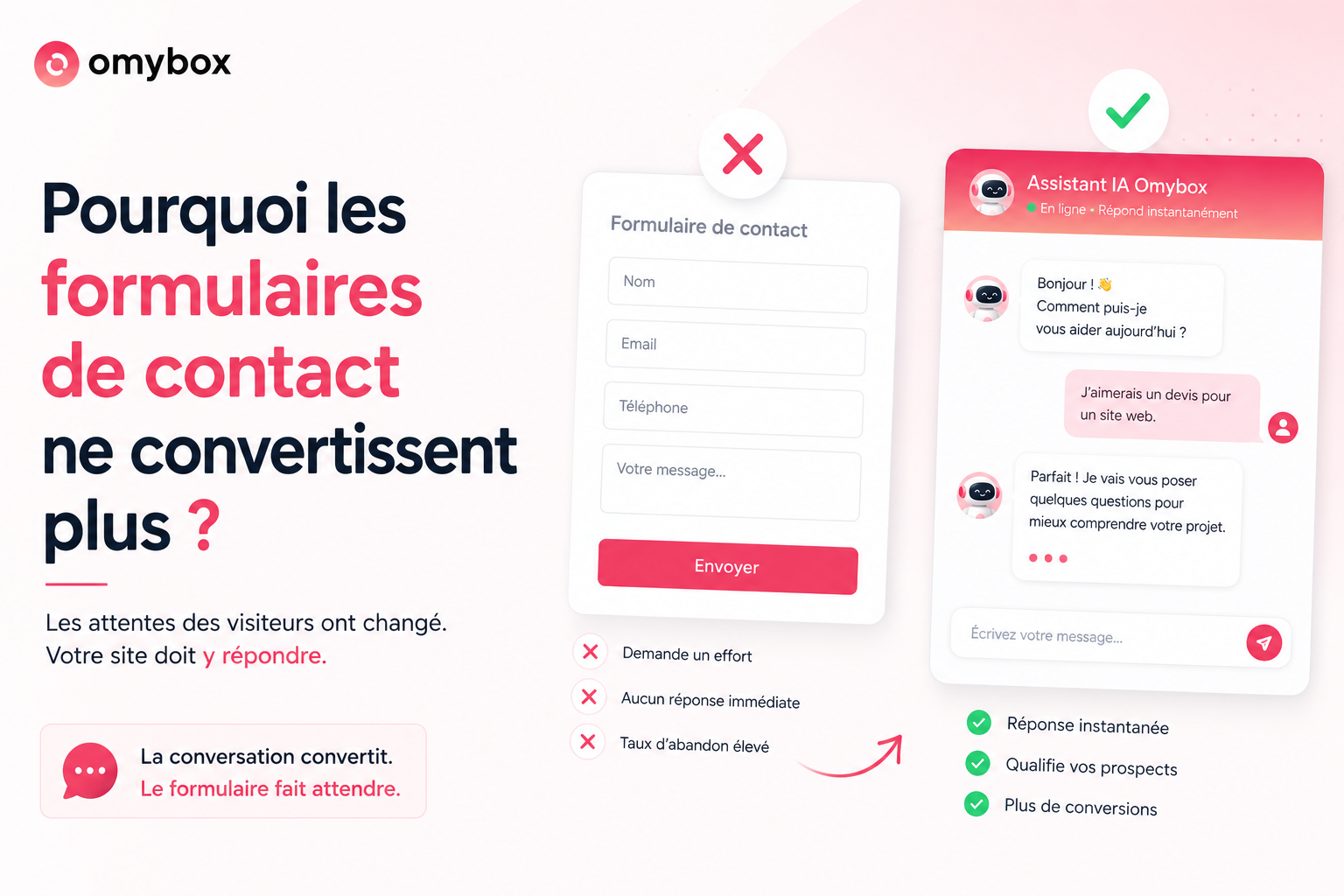
For years, contact forms have been the norm on websites.
“Contact us.” “Leave a message.” “We'll get back to you quickly.”
But today, user habits have changed.
And the reality is simple:
Visitors no longer want to wait.
In 2026, a traditional contact form is rarely enough to create a genuine interaction. The result: thousands of businesses lose opportunities every week without even realising it.
This article serves as a guide to understanding modern alternatives to contact forms, with concrete examples and use cases to help professionals choose the best solution.
So why are contact forms converting less and less? And more importantly, what alternatives exist today to genuinely improve a website's conversions? Throughout this article, we will explain what an AI assistant, an AI agent and a chatbot are, and detail their differences to help you better understand which one suits your business needs.
Visitors want instant answers
We live in an age where everything is instant.
Fast delivery
Answers in seconds
Immediate assistance
Real-time communication
When a visitor lands on a website, they now expect to get an answer quickly.
The problem with a traditional form is simple:
❌ no immediate interaction
❌ no real-time assistance
❌ no guidance
❌ no conversational engagement
The visitor has to:
fill in the fields,
explain their need,
click “send”,
then wait.
Traditional chatbots are often used to provide instant replies, but they remain limited to simple scripts and handling basic requests. By contrast, an AI chatbot can handle more complex requests, automate sorting or scheduling, and improve support efficiency. It is worth noting that AI assistants can take proactive initiatives, whereas chatbots are generally reactive, waiting for user input before responding.
And often… they leave the site before even receiving an answer.
Response time directly affects conversions
Several studies show that a prospect is far more likely to convert when they get a quick response.
Every minute of waiting increases the risk that:
the visitor loses interest,
contacts a competitor,
or abandons their enquiry altogether.
With a contact form, the request often leads to an exchange by e-mail, which can slow down the first contact and increase the number of times the visitor has to wait for a reply or follow up to get information.
Today, many businesses respond:
several hours later,
sometimes the next day,
or not at all.
And yet, the visitor was already ready to take action.
Forms create friction
A form requires effort.
The visitor has to:
thinking,
writing,
filling in several fields,
sometimes providing a phone number,
sometimes detailing their need.
The traditional way a form works relies on manual, sequential entry of information by the user, which creates friction at every step, unlike an automated solution that smooths the exchange by processing and answering requests instantly.
The more steps there are, the higher the drop-off rate.
This is especially true on mobile, where users look for simple, quick interactions.
In reality, many visitors simply want to:
ask a question,
get some information,
check a price,
or be reassured quickly.
And that is exactly what forms fail to deliver.
Modern visitors prefer a conversational experience
Today, users are used to:
WhatsApp,
Messenger,
ChatGPT,
AI assistants,
and instant conversations.
Behaviours have evolved.
Visitors no longer want to:
“submit a form”.
They want to:
chat.
A conversational experience makes it possible to:
respond immediately,
guide the visitor,
understand their needs,
and point them towards the right solution.
That is precisely what explains the explosion of conversational AI assistants on websites.
To go further, it is essential to compare AI assistant vs other solutions such as chatbots or AI agents. The question of AI assistant vs contact form then becomes central to choosing the best user experience.
Why businesses lose opportunities without knowing it
The biggest problem with forms is often invisible.
When a visitor leaves a site without filling in the form:
the business receives no information,
no contact,
no signal.
The prospect simply vanishes.
And in many cases, that visitor:
was interested,
had a purchase intent,
but did not quickly find what they were looking for.
The result: real opportunities are lost every day. The lack of automatic follow-ups via forms makes it impossible to re-engage these prospects, which directly contributes to the loss of opportunities.
AI assistants and AI chatbots completely change the user experience
Modern AI assistants turn a passive website into a genuine conversion tool.
Unlike a traditional form, an AI assistant can:
✔️ answer visitors instantly
✔️ understand their needs
✔️ qualify leads automatically
✔️ guide users
✔️ recommend services or products
✔️ automate certain actions
✔️ be available 24/7
AI assistants are designed to understand the context and nuances of interactions thanks to artificial intelligence and machine learning, whereas traditional chatbots often work with predefined scripts, limiting their ability to handle complex requests. An AI assistant can carry out multi-step logical workflows, while a chatbot is generally limited to simple interactions, such as answering frequently asked questions. Moreover, chatbots are mainly used for external interactions in customer service or marketing, whereas AI assistants focus on internal team productivity and optimising business processes.
An AI assistant, as software based on advanced technologies, can analyse files, emails or data to provide key insights, forecasts and support decision-making, giving users and executives genuine autonomy. Thanks to integration with productivity tools, anyone can automate appointment booking, email drafting or document preparation, saving several hours a week. Between an AI assistant and an AI agent, the difference lies in the level of autonomy and the ability to automate more complex and proactive processes.
AI assistants use natural language processing and machine learning algorithms to understand voice or text commands and carry out intelligent actions. This technology helps improve productivity, optimise workflows and boost the overall performance of teams. Automation through artificial intelligence also allows businesses to save an average of $11,000 per remote employee per year, highlighting the direct financial impact for executives who choose to adopt these solutions.
The visitor gets an interaction immediately.
And that completely changes the dynamics of conversion.
The difference between AI assistants and AI agents
In the world of artificial intelligence, it is common to confuse AI assistants with AI agents. Yet the difference between these two solutions is fundamental, especially when it comes to optimising the user experience on a website or automating business processes.
What is an AI assistant?
An AI assistant is designed to support the user with specific tasks, often in the form of a conversation. On an e-commerce or showcase website, it guides the visitor, answers their questions, gathers information through natural language, and makes it easier to book an appointment or qualify a request. AI assistants such as Omybox or modern chatbots specialise in direct interaction and in improving conversion rates through a smooth, personalised user experience.
What is an AI agent?
An AI agent goes further: it is capable of acting autonomously, making complex decisions and managing entire workflows without human intervention. For example, an AI agent can analyse data from several sources, orchestrate the sending of emails, automate invoice management, or run customer support processes from start to finish. AI agents use advanced technologies such as machine learning, natural language processing and, sometimes, retrieval augmented generation to adapt to varied situations and solve complex problems.
Omybox: a modern alternative to contact forms
That is exactly the problem Omybox was created to solve.
Omybox is an AI assistant designed for SMEs and e-commerce businesses that want to:
improve their customer experience,
respond more quickly,
automate conversations,
automatically handle product return requests,
and convert more visitors into customers.
Instead of a simple static form, Omybox lets you create a genuine conversational interaction right on your website.
The assistant can:
answer frequently asked questions,
automatically qualify enquiries,
guide visitors,
collect important information,
handle returns and refund requests,
and pass leads on to your teams.
All without a dedicated technical team.
The benefits of an AI assistant over a traditional form
Instant response
Visitors no longer wait for hours to get an answer.
More engagement
A conversation generates far more interaction than a static form.
Automatic qualification
The assistant can ask smart questions and identify the prospect's needs.
Available 24/7 for customer service
Even outside office hours.
Better user experience
Users feel supported and guided.
More conversions
Fewer visitors leave the site without interacting.
Will contact forms disappear?
Not entirely.
Forms can still be useful in certain cases:
complex requests,
recruitment,
specific support,
documents to submit.
But for most sales interactions, they are becoming less and less effective on their own.
The future of websites relies increasingly on:
conversation,
real-time assistance,
and smart experiences.
To conclude, this article has explained what an AI assistant is and the modern alternatives to contact forms, to help you better understand the current developments in digital communication tools.
Conclusion
Today's visitors no longer want to wait hours for an email reply after leaving a website.
They want to:
instant interaction,
a smooth experience,
and simple support.
Traditional contact forms create too much friction and let many opportunities slip away unnoticed.
AI assistants such as Omybox now allow SMEs and e-commerce businesses to: ✔️ respond instantly,
✔️ automatically qualify prospects,
✔️ improve the customer experience,
✔️ and turn more traffic into customers.
It is worth stressing that only 13% of micro, small and medium-sized businesses currently use artificial intelligence solutions, which represents a major opportunity to boost productivity through the appropriate use of these tools. According to a report by Accenture, the productivity of European workers now reaches only 76% of that of Americans, largely due to a lack of investment in technology, notably artificial intelligence. Modern AI assistants rely on machine learning to automate many tasks, allowing professionals to save several hours a week and optimise their efficiency.
Because in 2026, a high-performing website can no longer simply present a business.
It must interact, support and convert.
Go further
Further resources, chosen for this topic.
AI assistant for dental clinics
A complete example: patient questions, emergencies and appointment booking.
Omybox or Chatbase: the differences
Automated answers from your own data
Omybox plans and pricing
Find the plan that fits your visitor volume.
Omybox help centre
Installation, personalisation and conversation tracking.