Artificial intelligence is profoundly transforming the way businesses interact with their customers. For several years, chatbots have been the go-to solution for automating replies and reducing the workload of customer support.
Today, a new generation of tools is emerging: AI assistants.
But what is the real difference between a chatbot and an AI assistant? Why are more and more businesses abandoning traditional chatbots in favour of intelligent assistants? And above all, which one performs best for your business?
In this article, we compare the two approaches to help you make the best choice.
What is a chatbot?
A chatbot is a chat computer program used in online communication and customer service.
The first generations of chatbots worked according to predefined scripts:
scripted questions and answers;
decision trees;
trigger keywords;
static replies.
Even modern chatbots based on artificial intelligence increasingly rely on natural language processing and natural language to analyse text queries, but they often remain limited to consulting a knowledge base or the content of a website.
They are particularly effective for:
answering frequently asked questions;
providing basic information;
automating certain simple requests;
reducing the volume of support tickets.
To simply answer the question what is a chatbot, it is also a self-service-oriented conversational agent, often deployed on websites or within an application.
However, their ability to understand visitors' real intentions remains limited, with certain drawbacks as soon as they have to handle complex requests or less clear-cut cases.
What is an AI assistant?
An AI assistant is a form of artificial intelligence more advanced than a traditional chatbot.
Rather than simply answering a question, it seeks to understand:
the context;
the user's intent;
the goal of the conversation;
the information available about your business.
The AI assistant analyses exchanges as a whole, as well as the data available, and dynamically adapts its answers according to usage, context and environment.
Its role is no longer just to answer, but also to:
guide visitors;
qualify leads;
recommend solutions;
facilitate decision-making;
improve conversion.
Some AI assistants rely on generative AI, on models such as ChatGPT or on APIs from providers such as OpenAI.
In other words, the AI assistant acts more like a digital colleague than a simple support tool: it automates everyday tasks, lightens the workload and supports the team.
The limitations of traditional chatbots
Despite their popularity, chatbots have several limitations.
Often generic answers
Many chatbots answer simple questions correctly but struggle to provide relevant answers when a request becomes more complex, especially when there is a lack of context, history or quality data.
This can cause frustration among visitors. On simple cases, however, they can automatically resolve up to 60% of support questions.
Limited understanding of context
A chatbot often treats each question in isolation.
It understands longer discussions less well, because the handling of the nuances of natural language remains limited:
the conversation history;
the nuances of language;
implicit intentions.
Faced with a long exchange, some chatbots lose the thread and produce less relevant answers.
Weak conversion capability
The majority of chatbots were designed to answer.
Few were designed to persuade, guide or generate business opportunities, as support-oriented versions often struggle to recommend products or to personalise the exchange according to the person.
They also make poorer use of purchase history or user behaviour for marketing purposes.
Dependence on data quality
The more incomplete or poorly structured the data, the more the chatbot's performance declines, and AI assistants also need high-quality data to be truly effective. This applies notably to knowledge management, catalogues, CRMs or other business systems.
Why AI assistants perform better
Better understanding of intent
The AI assistant doesn’t just try to identify a question.
It tries to understand what the user actually wants to achieve, thanks to natural language processing and data analysis.
For example:
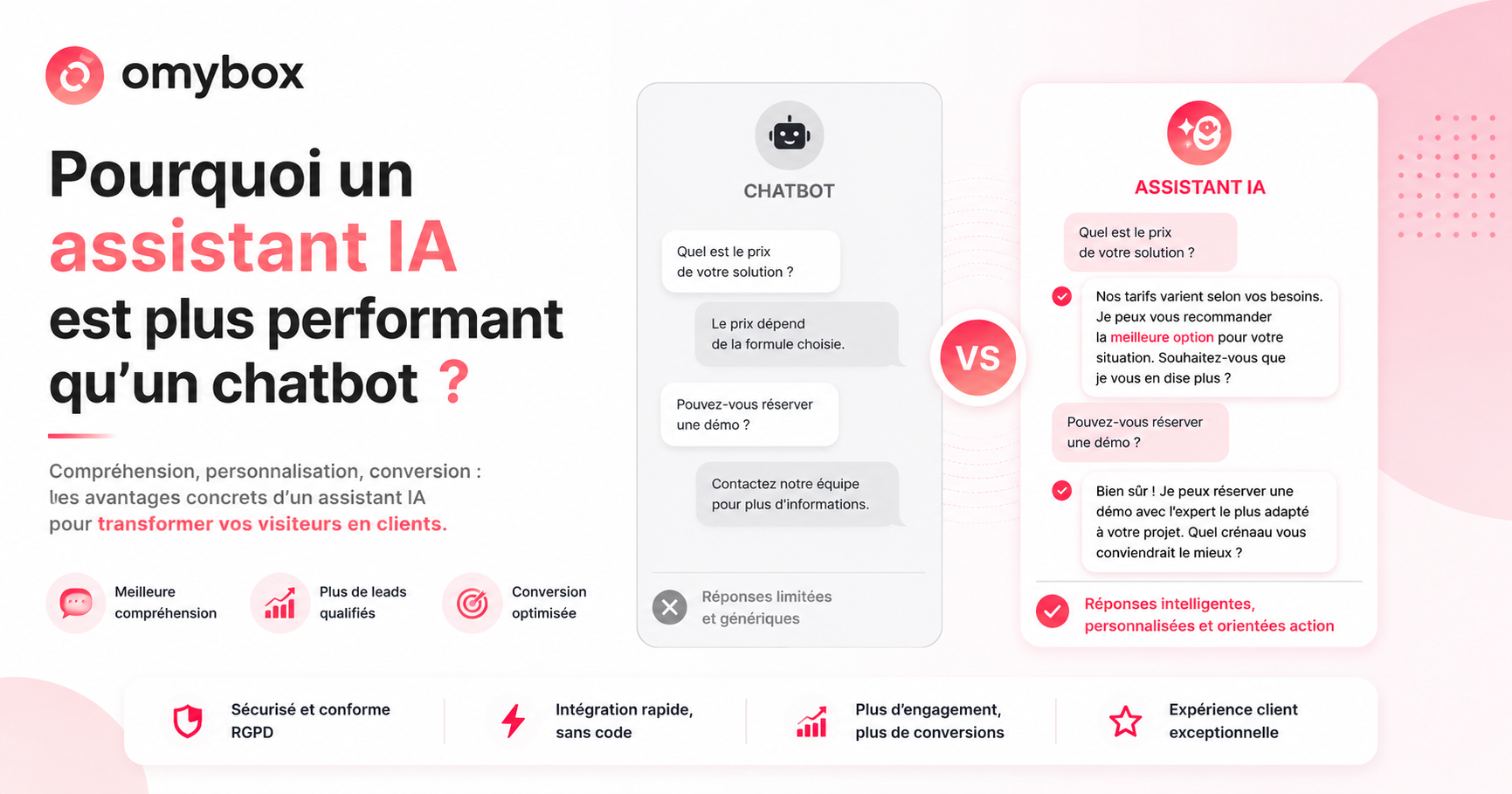
Question:
How much does your solution cost?
A chatbot will often reply with a price.
An AI assistant can also:
explain the different plans;
identify the visitor’s needs;
suggest the most suitable solution;
encourage them to get in touch.
It can also recommend the right plan based on the needs it detects and boost sales productivity.
More natural conversations
AI assistants use advanced models capable of keeping track of the context of a conversation, whether by text or voice, including in several languages.
The result:
smoother replies;
more human exchanges;
a better user experience.
A voice assistant such as Amazon Alexa illustrates this natural dialogue capability well, even though business use differs.
Better lead qualification
An AI assistant can gather key information:
industry sector;
company size;
specific needs;
budget;
goals;
interaction history and certain behavioural signals that are useful for qualification.
This data makes it possible to quickly identify the most qualified prospects.
Depending on the case, this qualification can also help with analysing complex data in finance or HR.
The ability to generate more leads
One of the main advantages of AI assistants is their impact on conversion: they can generate more leads while providing 24/7 support without interruption.
Rather than simply answering visitors, they can:
guide them towards a demo;
direct them to a suitable plan;
offer an appointment;
collect their contact details.
They also improve the user experience with tailored content and personalised recommendations.
They can be deployed on websites, an app or social media to unify communication.
AI assistant or chatbot: which should you choose?
The choice depends mainly on your goals.
Choose a chatbot if:
you want to answer simple questions;
your main need is customer support;
you are looking for a basic, low-cost solution, particularly for simple self-service on a limited budget.
Worth noting: only 5% of small and medium-sized businesses currently use chatbots and conversational assistants.
Choose an AI assistant if:
you want to generate more leads;
you want to improve your conversion rate;
you are looking for a smarter user experience;
you want to automate part of your sales process, with possible integration into the management, sales or support tools used by your team.
Furthermore, 13% of small and medium-sized businesses already use artificial intelligence solutions.
It can also support more advanced use cases, such as predictive maintenance in industry.
The future of online interactions
Expectations are evolving quickly in people’s everyday lives, across every communication channel.
Today, visitors want to get:
instant answers;
relevant replies;
personalised recommendations;
a seamless experience.
According to market trends, 85% of business leaders expect generative AI to be interacting with customers within two years.
Companies that continue to use limited tools risk gradually losing opportunities, as security and privacy risks become decisive once usage becomes widespread.
AI assistants represent the new generation of digital interactions. They not only improve the user experience but also help turn more visitors into customers.
Conclusion
For many years, chatbots have allowed businesses to automate their exchanges.
However, AI assistants now offer a far higher level of understanding, personalisation and performance, even though some drawbacks remain, particularly in terms of security, privacy and data quality.
If your only goal is to answer simple questions, a chatbot may be enough.
They become particularly useful when the business wants to automate more tasks without adding to the human workload.
On the other hand, if you want to improve the user experience, qualify your prospects and increase your conversions, an AI assistant is today the most powerful solution.
Go further
Further resources, chosen for this topic.
AI assistant for dental clinics
A complete example: patient questions, emergencies and appointment booking.
Omybox or Chatbase: the differences
Automated answers from your own data
Omybox plans and pricing
Find the plan that fits your visitor volume.
Omybox help centre
Installation, personalisation and conversation tracking.