Artificial intelligence is gradually becoming established in businesses to automate customer support, answer visitors and improve website conversion.
But one question keeps coming up among European businesses: which AI chatbot truly complies with GDPR?
It's a fair question. Today, many AI solutions store data outside Europe, lack transparency, use conversations to train their models or don't give businesses enough control.
For SMEs, practices, agencies, medical or legal firms, the issue is becoming critical.
Why is GDPR a major issue for AI chatbots?
An AI chatbot often processes personal data such as names, email addresses, phone numbers, customer requests, commercial information and sometimes even medical or legal data.
In Europe, this data is governed by GDPR. A business using a non-compliant AI solution may expose its customers' data, create legal risk, lose the trust of its users or run into compliance problems.
So the issue is no longer purely technological. It is also a question of credibility and security.
To explore this further, you can read our dedicated page on Omybox's GDPR compliance and DPA.
Not all AI chatbots are GDPR-compliant
This is a common mistake. Many popular AI tools are mainly designed for the American market.
The result: some solutions may host data outside the EU, offer little control over data, keep conversations for unclear periods, have an unclear policy on AI training or make it hard to handle data deletion requests.
Some platforms collect a great deal of information without businesses really being aware of it.
How can you tell whether an AI chatbot complies with GDPR?
Here are the essential criteria to check before choosing an AI chatbot solution for your business.
Data hosting
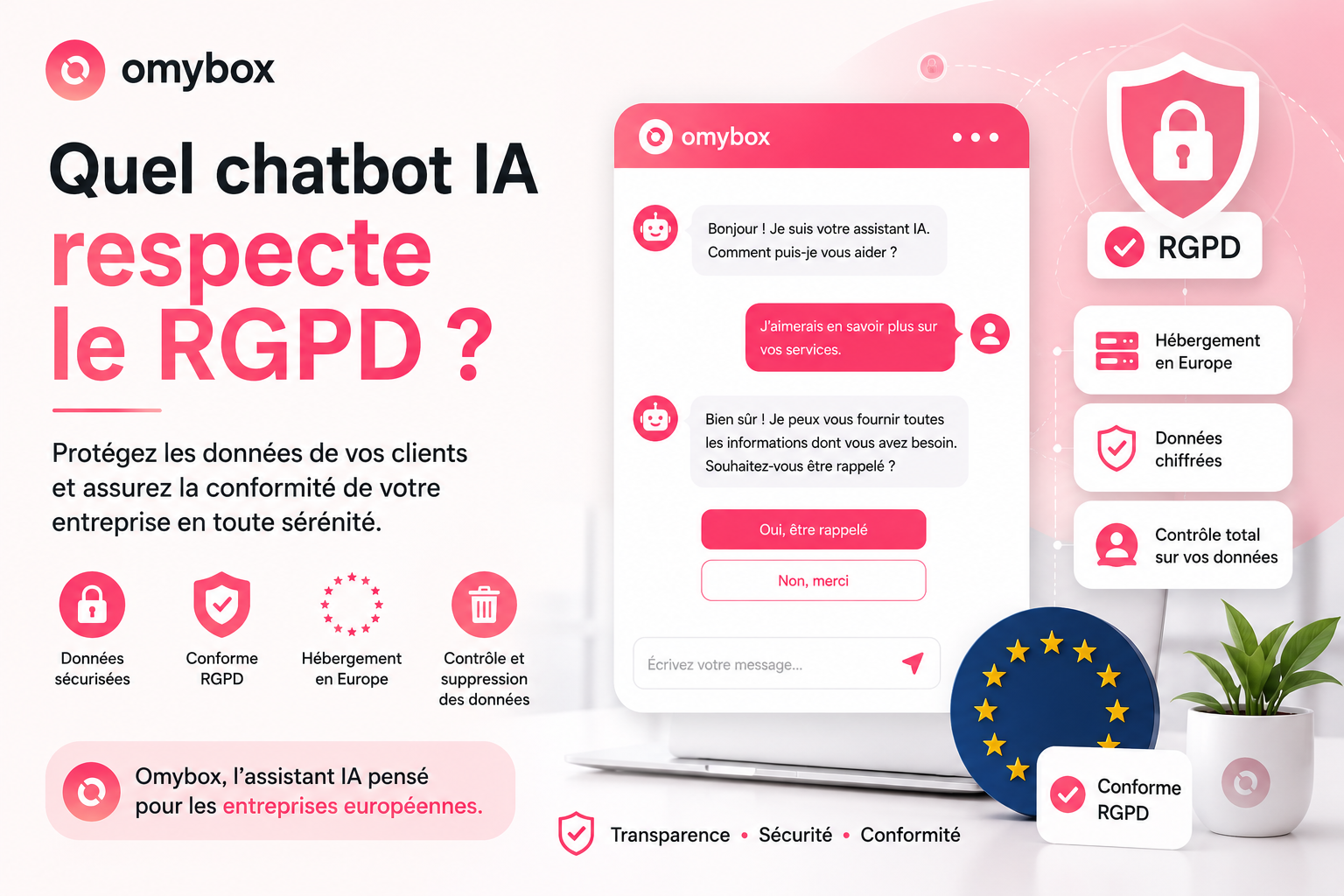
The first critical point concerns hosting. A GDPR-friendly AI chatbot should ideally offer hosting in the EU, secure exchanges, protect user data and be transparent about the servers it uses.
Data control
A business should be able to access conversations, delete data, control how long it is kept and manage consent.
Without this, compliance quickly becomes complicated.
Transparency about how AI is used
Some platforms use conversations to train their AI models. The problem is that businesses don't always know what is actually kept or exploited.
A serious solution should clearly explain how data is used, what is stored, what is shared and how the information is protected.
Securing exchanges
Conversations should be secured through encryption, access protection, limiting the risk of leaks and rigorous permission management.
This is especially important for law firms, clinics, accounting firms, B2B companies and organisations handling sensitive data.
The limits of many mainstream AI chatbots
Many popular AI solutions are very powerful, but not necessarily suited to European requirements.
Some platforms prioritise speed over compliance, are designed for large American companies, require complex setup or remain vague about how data is managed.
For a European SME, this can quickly become a problem.
Why are European businesses looking for more secure alternatives?
Businesses now want a simple solution, capable AI, quick integration and a more serious approach to privacy.
The market is clearly moving towards AI assistants that are more transparent, more secure and better suited to GDPR.
This need also ties in with the search for simpler, more business-focused tools, as explained in our article on the best AI assistant for SMEs.
Omybox: an AI assistant designed for European businesses
Omybox was designed to meet the needs of businesses that want to adopt AI without compromising on security and compliance.
Omybox's aim is not simply to add a chatbot to a website, but to create an AI assistant that automates customer enquiries, qualifies prospects, improves conversion and maintains a serious approach to data management.
Omybox is especially suited to SMEs, law firms, agencies, clinics, service companies and European organisations looking for a modern, professional solution.
The platform can also be fed with your company's content to improve its answers. To understand how this works, read our article on AI chatbots that can read the content of a website.
Is a GDPR-compliant AI chatbot mandatory?
If your company collects personal data through a chatbot, complying with the GDPR becomes essential.
This applies in particular to automated forms, appointment booking, customer conversations, contact details and sales enquiries.
Ignoring this aspect can become a significant legal and reputational risk.
The criteria for a good AI chatbot for a European company
The best GDPR-compliant AI chatbot is generally a solution that combines conversational intelligence, simplicity, security, transparency and tailoring to your business.
The goal is not simply to have a trendy AI. The goal is to have a tool that is genuinely useful for the business.
To compare the different solutions available, you can also read our comparison of the best AI chatbots.
Conclusion
AI is becoming a strategic tool for businesses. But not all solutions are equal when it comes to privacy and compliance.
Choosing a GDPR-friendly AI chatbot helps protect customer data, strengthen trust, limit risks and build a more professional relationship with your visitors.
European companies will increasingly need AI solutions that combine performance, simplicity and compliance.
FAQ – Which AI chatbot complies with the GDPR?
Can an AI chatbot be GDPR-compliant?
Yes. An AI chatbot can be GDPR-compliant if it follows certain rules, such as data protection, transparency about how data is processed and securing conversations.
Why is the GDPR important for an AI chatbot?
A chatbot often collects personal data such as email addresses, phone numbers or customer enquiries. The GDPR governs how this data is stored and used.
What are the risks of a non-compliant AI chatbot?
The main risks are data leaks, lack of transparency, failure to follow European rules, loss of customer trust and legal exposure.
How can you tell whether an AI chatbot complies with the GDPR?
Check where data is hosted, the security measures in place, transparency about how data is used, deletion options and the privacy policies.
Which AI chatbot should a European company choose?
European companies generally favour secure, transparent, scalable solutions that meet GDPR requirements, such as Omybox.
Can an AI chatbot store sensitive data?
Yes. That is why it is essential to choose a solution that is secure and suited to European regulations.
Go further
Further resources, chosen for this topic.
AI assistant for dental clinics
A complete example: patient questions, emergencies and appointment booking.
Omybox or Chatbase: the differences
Automated answers from your own data
Omybox plans and pricing
Find the plan that fits your visitor volume.
Omybox help centre
Installation, personalisation and conversation tracking.